
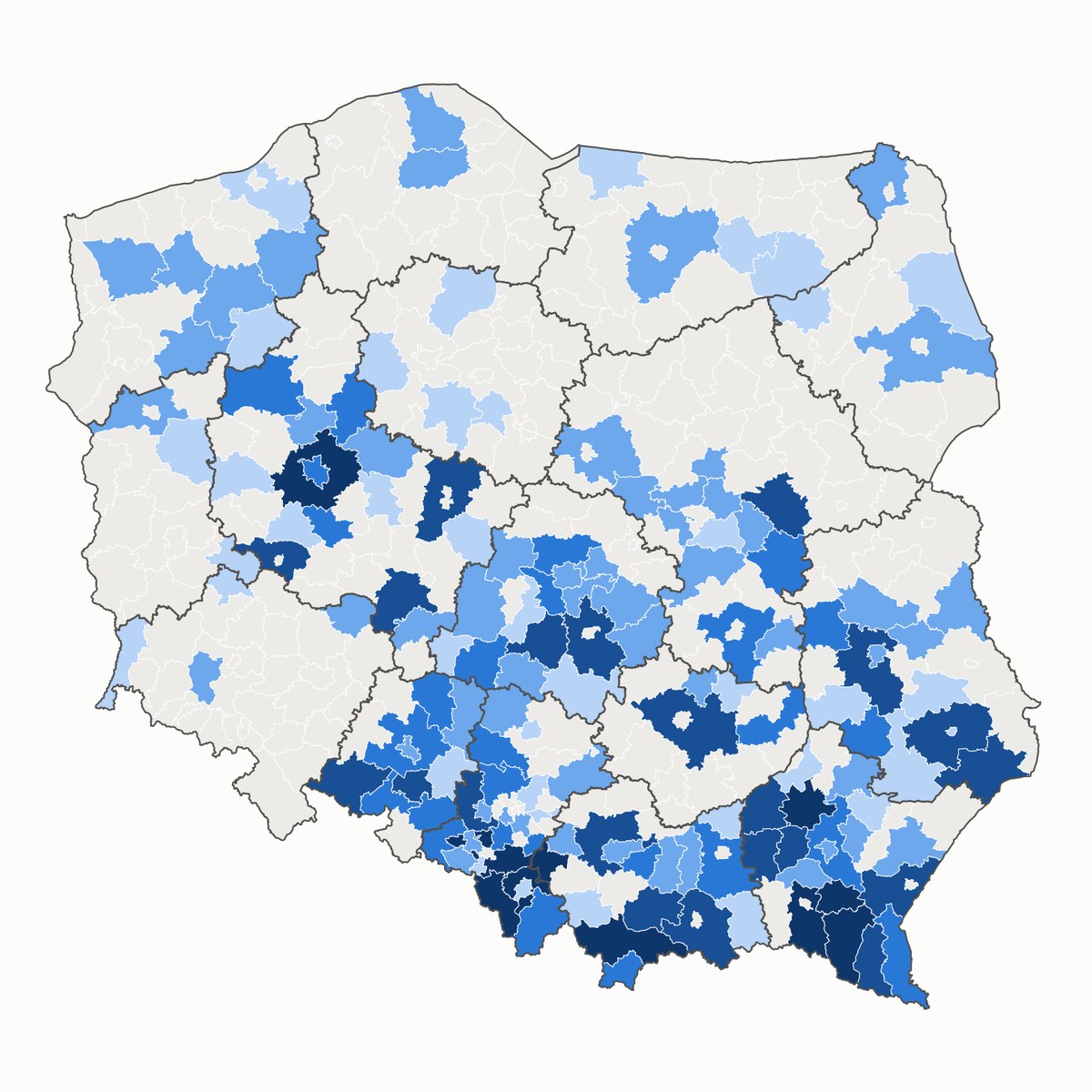
Where does foulbrood appear next? A spread model for AFB and EFB, and a forecast for Poland
Reported American foulbrood does not appear at random. In Poland, a powiat with a reported outbreak in the last 12 months is 14 times more likely to report another one in the next year than a powiat with no reported outbreak in 3 years and none in its neighbours. We used this fact to build a spread model from official veterinary records. It looks at the month, the outbreak history of each powiat and the history of its neighbours, and gives the chance of at least one new reported outbreak in the next one or three months. On the years it never saw in training, it ranks powiats with a ROC AUC of 0.903, and with the same number of checks it finds more outbreaks than the simple rule "check the powiats that had an outbreak last year". The same method works in Switzerland for American foulbrood and for European foulbrood. This article explains how the model works, how well it works, and what it says for Poland for October to December 2026.
1. What are American and European foulbrood?
American foulbrood (AFB) is caused by the bacterium Paenibacillus larvae. It kills the larvae in capped cells. The bacterium makes spores, which stay in comb, honey and hive parts for a long time. In Poland AFB is a notifiable disease. A beekeeper who suspects it must report it to the powiat veterinary officer. When the outbreak is confirmed, an act of the powiat veterinary officer or the voivode declares an infected area around the apiary.
European foulbrood (EFB) is caused by another bacterium, Melissococcus plutonius. It kills younger, open larvae. Poland publishes no records of EFB per region and month, so for EFB we used the Swiss records (Section 5).
How does foulbrood get from one apiary to the next? Published studies show two ways.
- Bees. Bees that rob a colony that died of AFB take spores home. In a field experiment, AFB passed between apiaries through robbing within 1 km of the diseased colonies, and much less at 2 km or more (Lindström et al., 2008, Apidologie). In a model of an AFB epidemic on Jersey, most spread that depended on distance was shorter than 2 km (Datta et al., 2013).
- People. Over tens of kilometres, AFB moves with the beekeeper: sold colonies and nuclei, moved combs and used equipment (Ågren et al., 2017).
The official records can tell which of the two matters more in Poland. We return to this in Section 6.
2. What do the official records show?
The Chief Veterinary Inspectorate (GIW) publishes a monthly bulletin with the number of AFB outbreaks in each powiat. We collected all bulletins from January 2016 to September 2026. From 2018 the bulletin counts outbreaks; before 2018 it counts villages, so we use those two years only as history.
This article is about reported AFB. The bulletin lists only the outbreaks that a beekeeper or a veterinary inspector found and that were confirmed. Some infected colonies are never found: the beekeeper does not see the signs, or the colony dies and is robbed out before anyone checks it. These hidden outbreaks can spread AFB too, but no record shows them. So every number in this article, and every forecast, is about reported outbreaks. The real number of infected apiaries is probably higher.
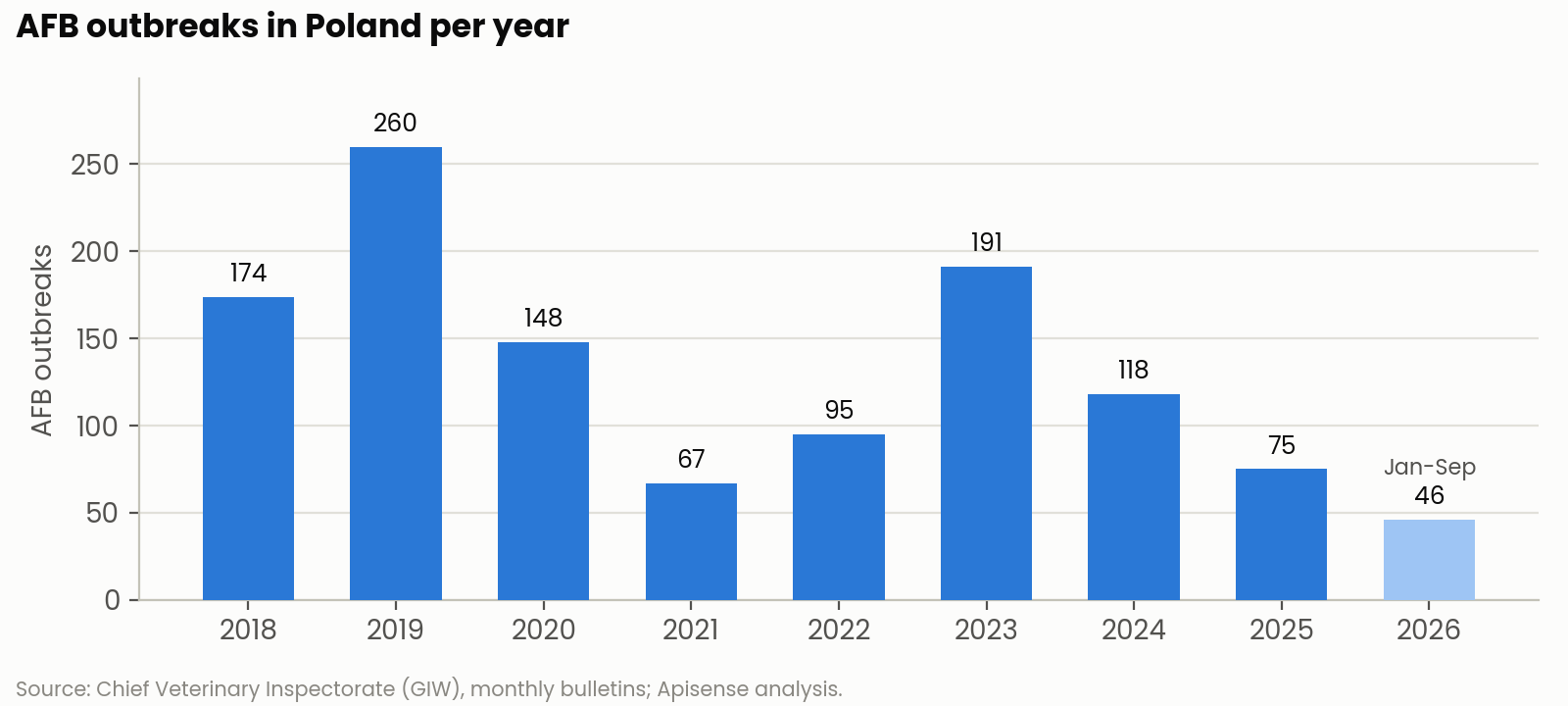
The number goes up and down from year to year, between 67 and 260. Three facts in these records matter for a forecast.
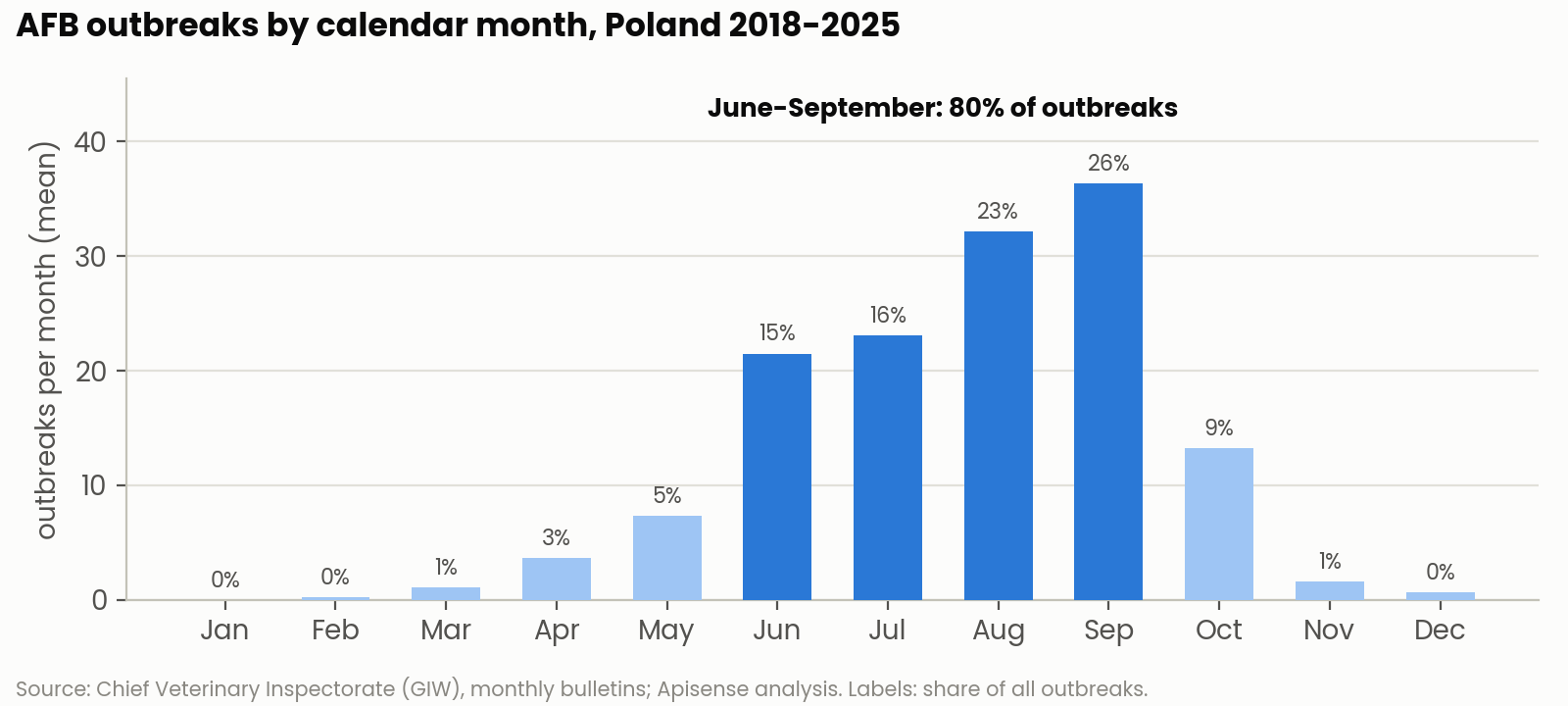
AFB is a summer disease in the records. 80 percent of the outbreaks of 2018-2025 were reported from June to September. September alone had 26 percent. January had none, and November, December and February together had 2 percent. This is when beekeepers open their hives and when inspectors visit them, so it says when AFB is found, not only when it is active.
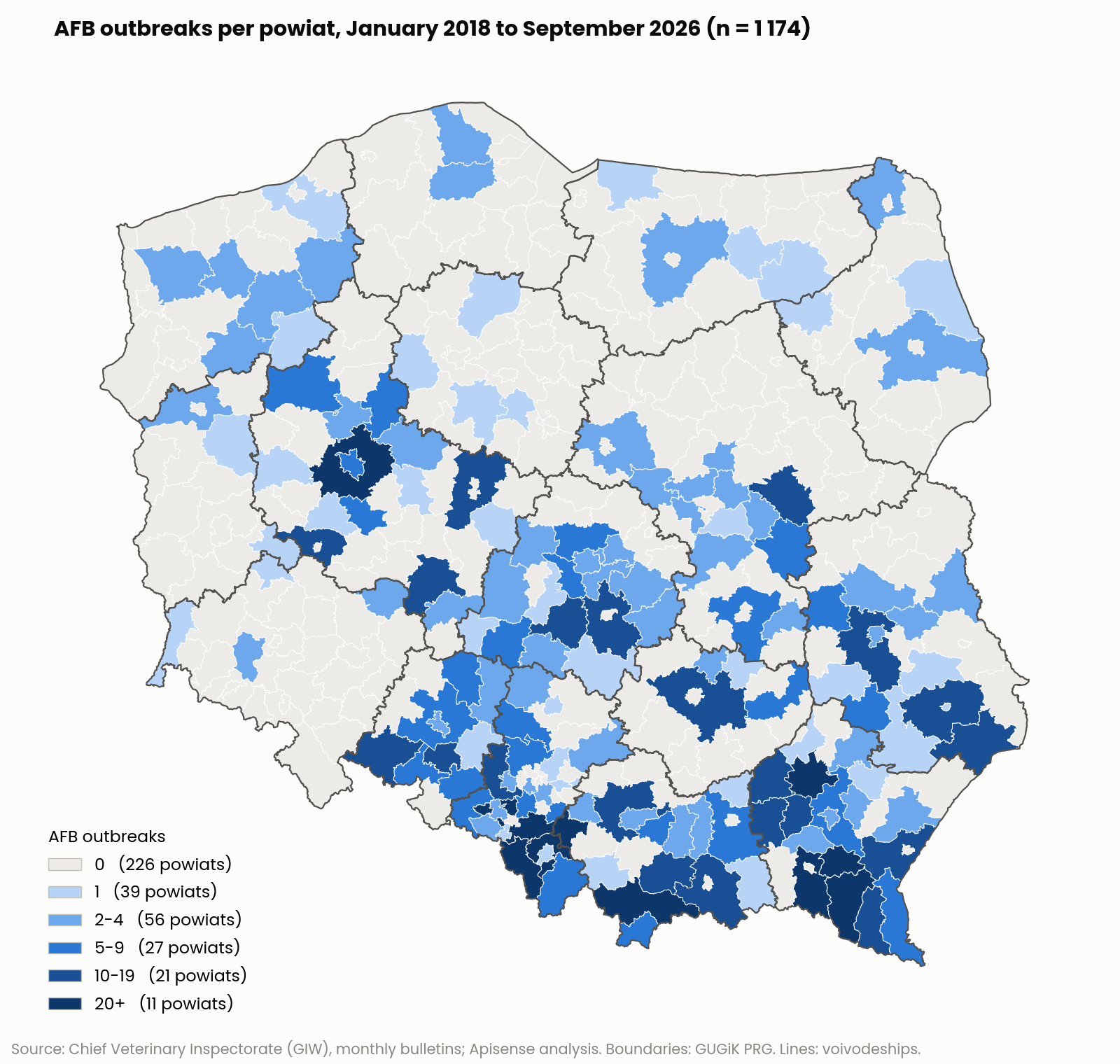
AFB is concentrated. 38 powiats, 10 percent of all powiats, had 74 percent of the outbreaks of 2018-2026. Most are in the south, along the Carpathians and in Silesia, as the map at the top shows.
AFB is reported again in the same places. We split the powiats into four groups on 1 January of each year from 2019 to 2025 and counted how many had an outbreak in the next 12 months.
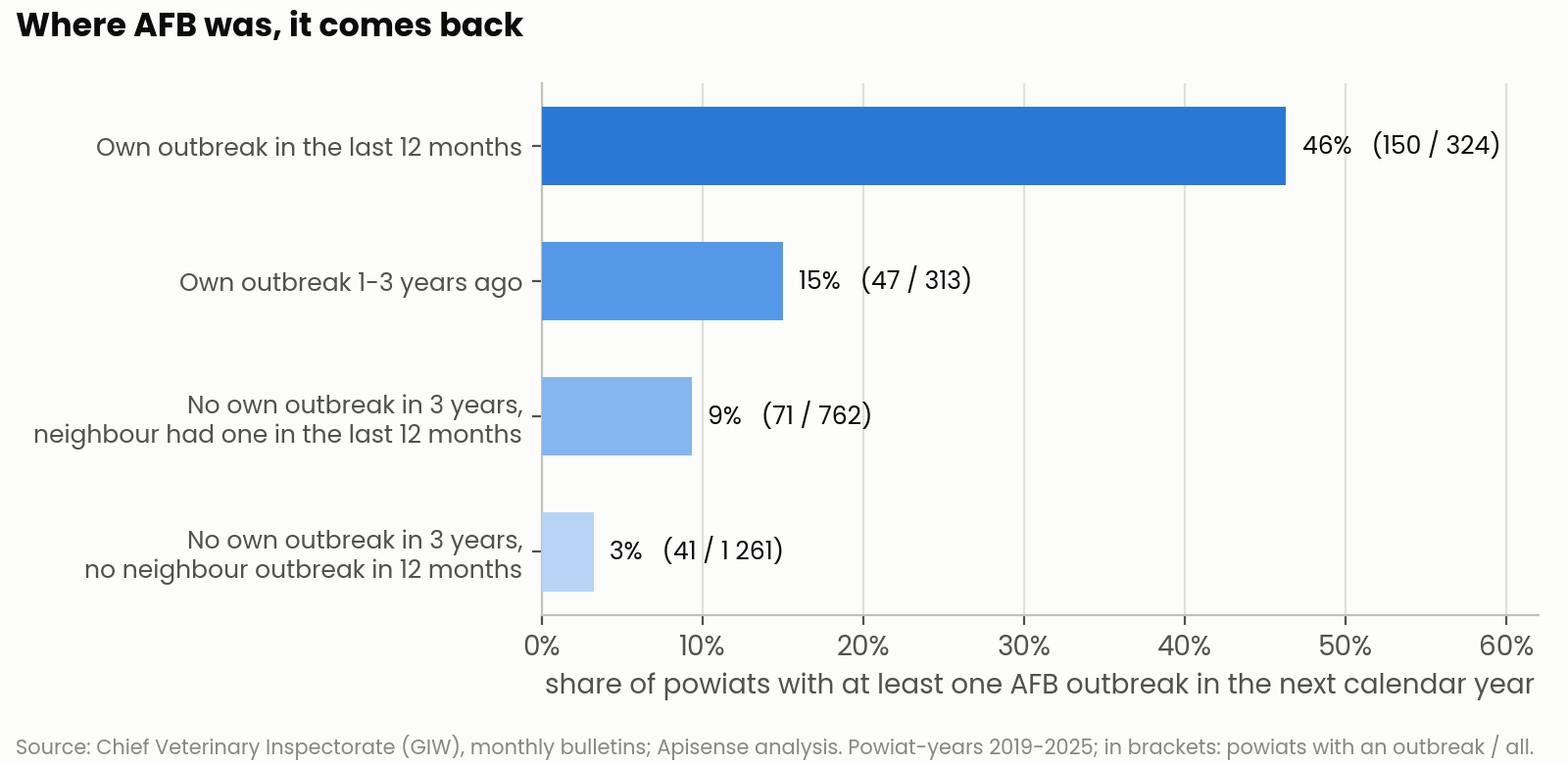
Almost half of the powiats with an outbreak in the last 12 months had another one in the next year (46 percent). Of the powiats with no outbreak in 3 years and none nearby, only 3 percent had one. A neighbour with an outbreak raises the chance to 9 percent. Part of this pattern may come from more inspections around a known outbreak (Section 9). The spread model turns these differences into a number for each powiat.
3. How does the spread model work?
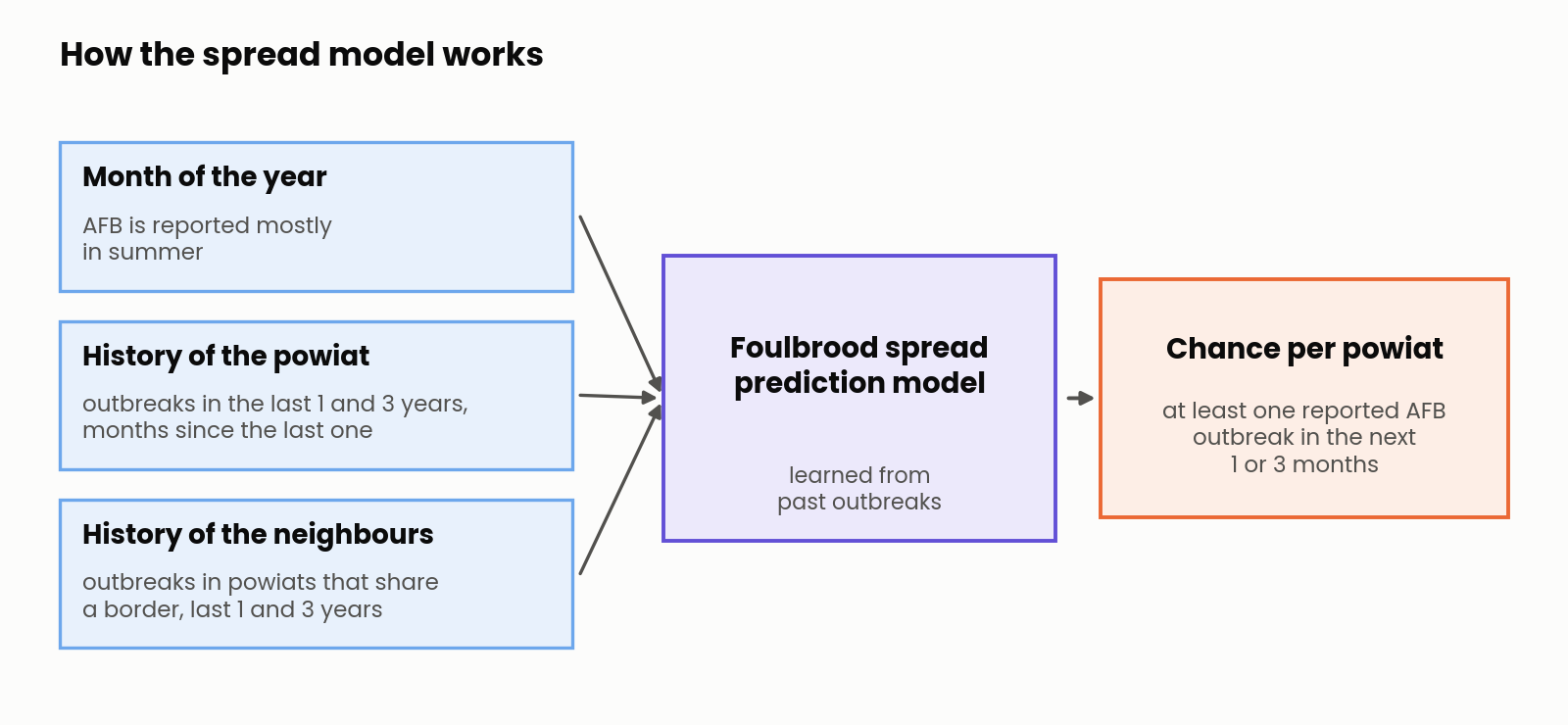
For each powiat and each month, the model looks at three things:
- The month of the year. An outbreak in August is far more likely than in January.
- The history of the powiat. The number of outbreaks in the last 12 and 36 months, and the number of months since the last outbreak.
- The history of its neighbours. The number of outbreaks in the last 12 and 36 months in all powiats that share a border with it. A powiat has about five neighbours on average.
The foulbrood spread prediction model combines these inputs into one probability between 0 and 1. It learns from past months, where we already know whether an outbreak came. The output is the chance of at least one reported AFB outbreak in the powiat in the next month, or in the next three months.
We also tried gradient boosting, a more flexible machine-learning model, on the same inputs, and it was not better (ROC AUC 0.896 against 0.903). We also added a term for the distance to all outbreaks in Poland, not only in neighbouring powiats. It added nothing.
4. How well does the model predict outbreaks?
To test a forecast honestly, you must test it on data that it did not see. We fitted the model on the years 2019-2022 only and tested it on January 2023 to September 2026. Every test month comes after all the training data, as in real use.
We measure the result with the ROC AUC. Take one powiat-month with an outbreak and one without, at random. The ROC AUC is the probability that the model gives the higher risk to the one with the outbreak. 0.5 is a coin toss, 1.0 is a perfect ranking.
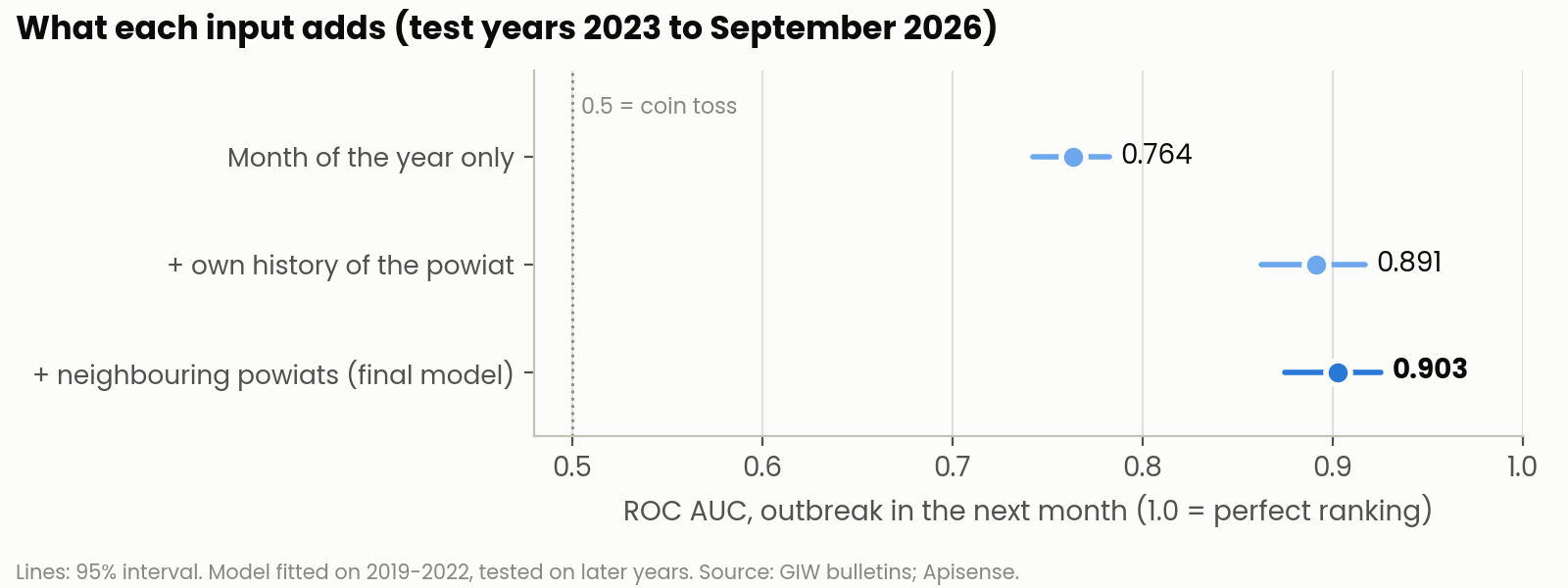
The final model has a ROC AUC of 0.903 for the next month and 0.873 for the next three months. The season alone gives 0.764. The history of the powiat itself adds the most. The neighbours add a small gain, 0.011 for the next month. The gain stays when we remove podkarpackie or śląskie, the two voivodeships with the most outbreaks. For powiats with no own outbreak in the last 3 years, the neighbours are the only signal, and there they raise the ROC AUC from 0.727 to 0.783.
A ROC AUC is abstract, so here is what it means in practice. Sort all 17,100 powiat-months of the test years from the highest to the lowest predicted risk.
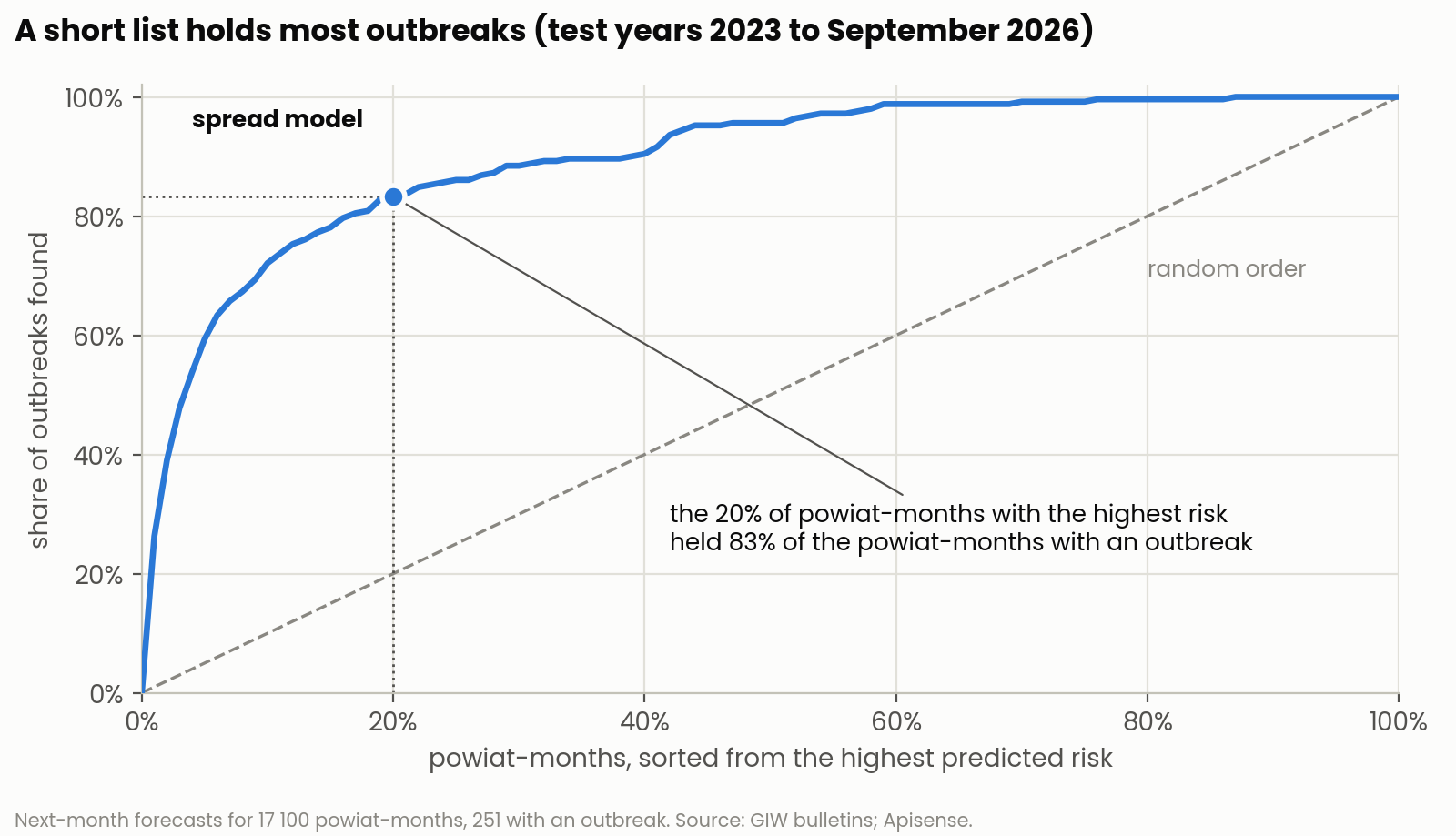
The 20 percent at the top of the list held 83 percent of the 251 powiat-months with an outbreak. The 10 percent at the top held 72 percent.
Is the model better than a simple rule? An inspector does not need a model to say "check the powiats that had an outbreak in the last 12 months". So we compared the two with the same number of checks. In the test years this rule picks 10.5 percent of all powiat-months and finds 64.9 percent of the powiat-months with an outbreak. The model, with the same number of checks, finds 72.5 percent. To find as many outbreaks as the rule, the model needs 37 percent fewer checks. The rule misses every outbreak in a powiat with no outbreak in the last year. The model still gives those powiats a risk, from the season and from their neighbours. If we also limit the rule to April to October, it gets close to the model: 62.5 percent of the outbreaks for the rule and 64.1 percent for the model, with the same number of checks. Most of the gain over a simple rule comes from the calendar and from the powiats with no recent outbreak.
Two more checks for rare events. Only 1.5 percent of the powiat-months had an outbreak. With events this rare, a ROC AUC can look good even for a weak model, so we also report two measures that are strict with rare events. The average precision (PR AUC) is 0.285, which is 19 times the value of a random order (0.015). The Brier score, the mean squared error of the predicted probabilities, is 0.0121. A forecast that gives every powiat the same average chance has 0.0145, so the model is 16 percent better.
The probabilities are also realistic. In the test years, the powiat-months that the model put at 10 percent or more had an outbreak in 25 percent of cases, and the model predicted 25 percent on average for them. The powiat-months below 1 percent had an outbreak in 0.2 percent of cases. But a low risk is not zero risk: 27 of the 251 powiat-months with an outbreak, about one in nine, came from the group below 1 percent.
5. Does the method work in another country?
A model can work in one country by chance. To check this, we applied the same code to the Swiss database of notifiable animal diseases of the Federal Food Safety and Veterinary Office (FSVO). It is open data and lists every AFB and EFB outbreak since 1991 with the municipality and the date: 2,605 AFB and 9,165 EFB outbreaks. Switzerland has other veterinary rules and smaller regions than Poland: 144 districts, with a median area of about 186 km², against about 880 km² for a Polish powiat.
We used the same inputs, the same training years (2019-2022) and the same test years (2023 to October 2026).

For AFB in Switzerland the ROC AUC is 0.885 for the next month, close to Poland (0.903). Switzerland had only 74 AFB outbreaks in the test years, so the interval is wide.
For EFB in Switzerland the ROC AUC is 0.906 for the next month. The top 20 percent of district-months held 81 percent of the district-months with an outbreak. EFB is reported earlier in the year than AFB: 78 percent of the Swiss EFB outbreaks of 2019-2026 were reported from April to June.
All three models are within 0.885 to 0.906. As in Poland, the own history of the region carries most of the signal, and the neighbours add a little.
6. How far does AFB jump?
The bulletin gives only the powiat. To measure distances, we used a second official source: the acts that declare an infected area around each outbreak, published by the powiat veterinary officers and the voivodes in the official journals of the voivodeships. From 916 acts of 2018-2026 we took the place of each new outbreak and measured the distance to the nearest outbreak of the previous two years. We did the same for random places in Poland, as a comparison.

Only 14 percent of new outbreaks were within 5 km of an earlier one, the distance that bees fly to forage. 86 percent were farther. The median distance was 15 km. New outbreaks are closer to old outbreaks than random places are (median 41.9 km anywhere in Poland, 25.7 km in the same voivodeship), so AFB does spread from place to place. But it spreads mostly at 10 to 50 km, not next door.
This agrees with the published studies in Section 1. Robbing explains short jumps. Jumps of tens of kilometres come with people: sold colonies, moved hives, used combs and equipment. It is also why the model works at the level of the powiat and its neighbours.
7. Which powiats are at risk from October to December 2026?
On 17 November 2026, the latest published GIW bulletin was for September 2026. The October bulletin was not yet online. We fitted the final model on all records from 2016 to September 2026, with the same code and settings as in the test, and calculated two numbers for each powiat:
- the chance of at least one reported AFB outbreak in October 2026 (next month);
- the chance of at least one reported AFB outbreak in October to December 2026 (next three months).
These months have partly passed. GIW publishes each bulletin some weeks after the month ends, so this is a forecast of records that are not yet public.
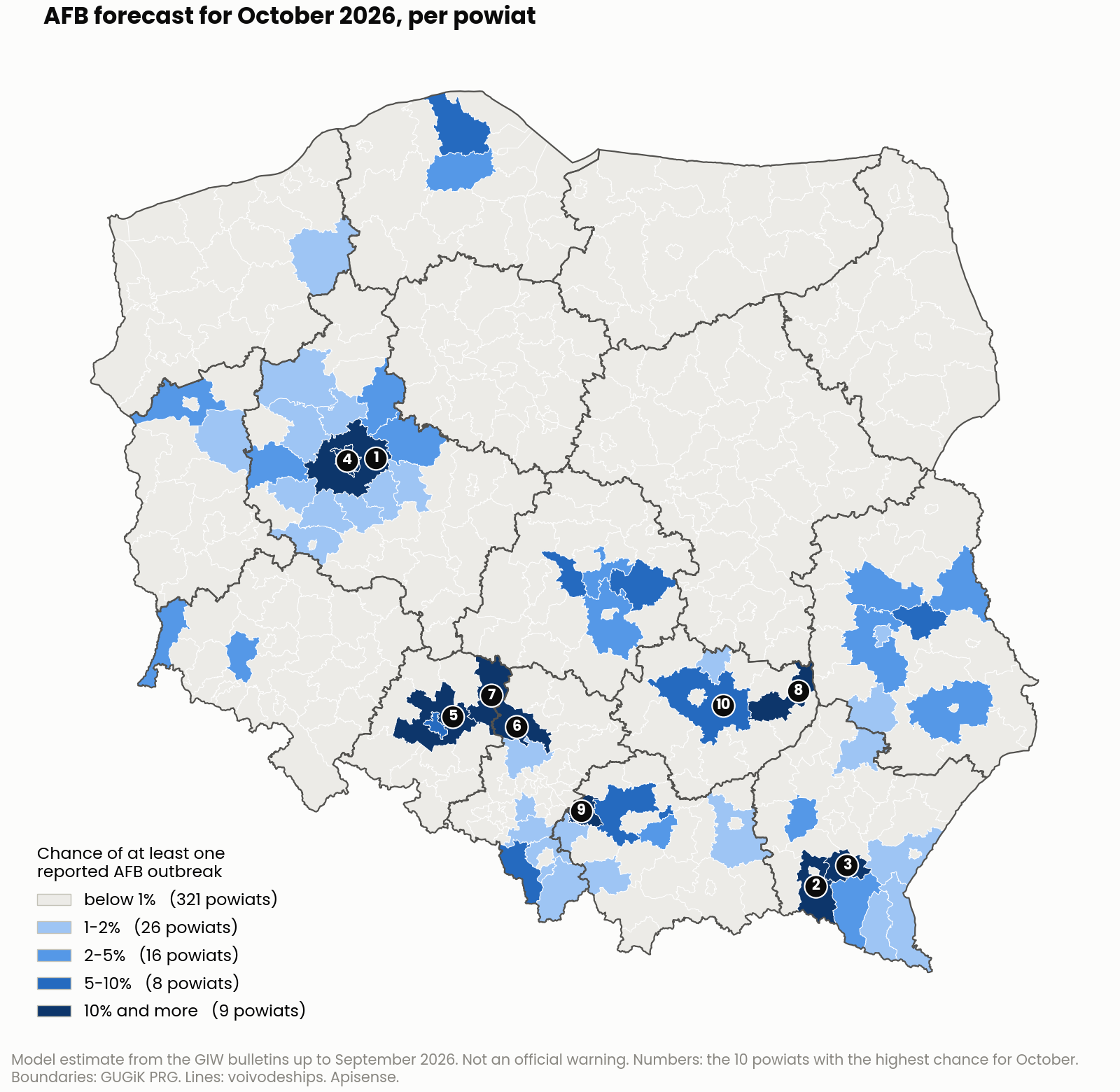
| # | Powiat | Voivodeship | October 2026 | October-December 2026 | AFB outbreaks, Jan 2025-Sep 2026 |
|---|---|---|---|---|---|
| 1 | poznański | wielkopolskie | 37% | 41% | 24 |
| 2 | krośnieński | podkarpackie | 20% | 25% | 4 |
| 3 | brzozowski | podkarpackie | 20% | 26% | 8 |
| 4 | Poznań (city) | wielkopolskie | 20% | 22% | 3 |
| 5 | opolski | opolskie | 15% | 16% | 3 |
| 6 | lubliniecki | śląskie | 14% | 15% | 3 |
| 7 | oleski | opolskie | 14% | 14% | 2 |
| 8 | opatowski | świętokrzyskie | 14% | 14% | 4 |
| 9 | chrzanowski | małopolskie | 12% | 12% | 2 |
| 10 | kielecki | świętokrzyskie | 10% | 11% | 2 |
The ten powiats with the highest chance of a reported AFB outbreak in October 2026.
What the forecast says:
- The risk is in a few places. Nine powiats are at 10 percent or more for October, and 17 at 5 percent or more. 321 of the 380 powiats are below 1 percent.
- The top of the list is where AFB was found in late summer. All ten powiats in the table had at least one outbreak in August or September 2026. Powiat poznański is first because it had 13 outbreaks in the last 12 months. The city of Poznań is fourth mainly because of its neighbour.
- The model expects few outbreaks. If we add up the chances, the model expects about 5 powiats with a reported outbreak in October 2026. From 2018 to 2025, between 4 and 17 powiats reported an outbreak in October, 9 on average. 2026 has been a quiet year so far, with 46 outbreaks from January to September.
- The next three months add little to October. For October to December, the expected number rises only from 4.6 to 5.2 powiats. The same ten powiats are at the top.
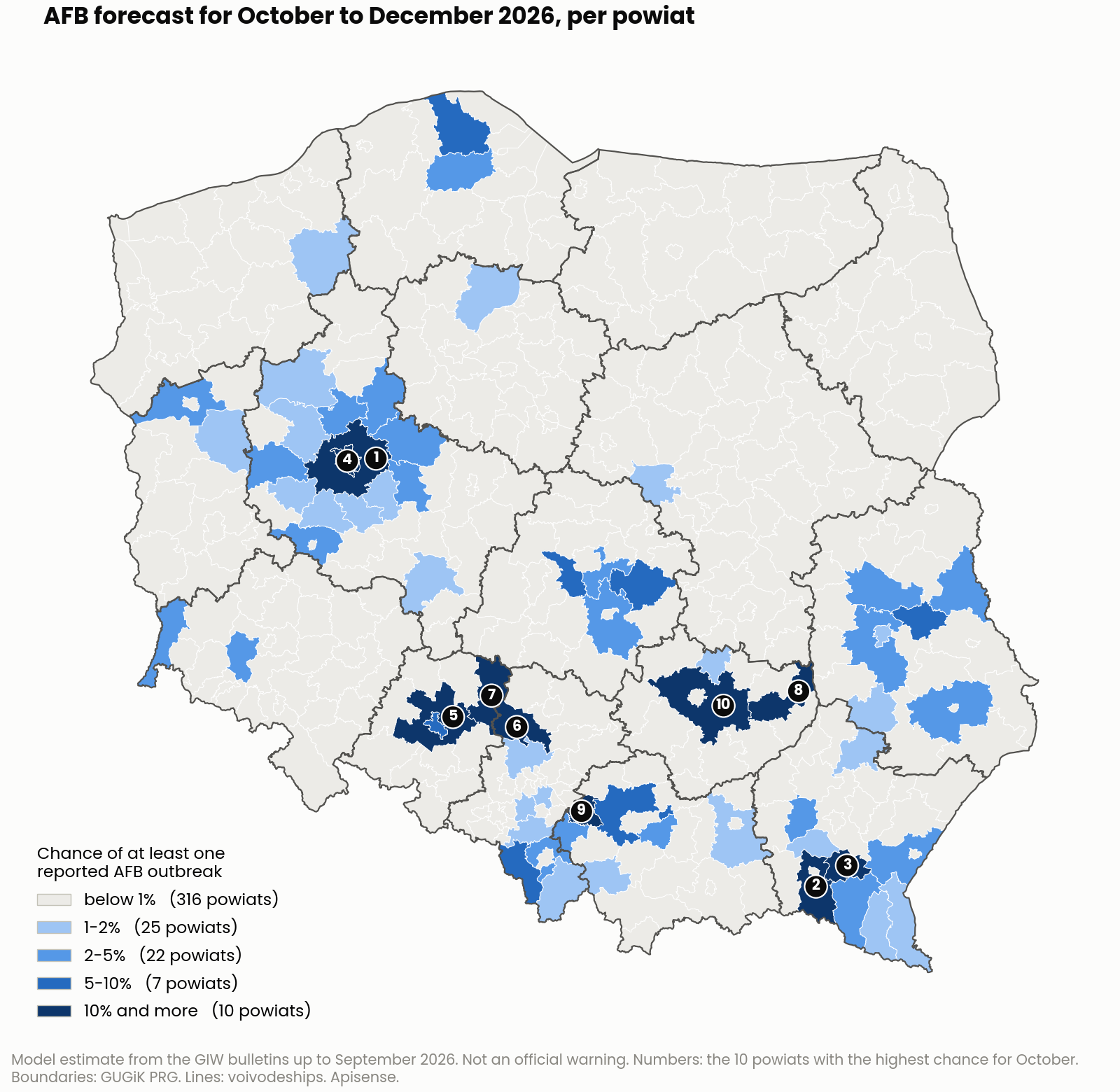
Why the risk falls in winter. The model does not know about weather. It knows the calendar. From 2018 to 2025, Poland had on average 1.4 powiats with an AFB outbreak in November, 0.4 in December and none in January. The colonies are in winter cluster and beekeepers do not open the hives to inspect brood. The bacteria do not disappear. The spores stay in the combs and the honey. In the records, outbreaks start again in April and May, with 3 and 5 percent of the yearly total.
This forecast is a statistical estimate from public records. It is not an official warning and it does not replace the decisions of the veterinary inspection. A powiat with a low chance can still have an outbreak. In the test years, about one in nine powiat-months with an outbreak had a predicted chance below 1 percent.
8. What should beekeepers do?
The data says that AFB is reported again in the places where it was reported before, and that it travels tens of kilometres with people. Here is what follows from this in practice, in any powiat, and more so in the powiats at the top of the list.
- Check the brood at the first spring inspection. Look for sunken, darkened or perforated cappings and a patchy brood pattern. If you suspect AFB, report it to the powiat veterinary officer. This is a legal duty in Poland.
- Do not move colonies, combs or used equipment out of an infected area, and do not buy them from an apiary that you do not know. This is the route of the long jumps in Section 6.
- Do not feed bees with honey from another apiary. Honey can carry AFB spores, and spores in honey reach the larvae when the bees use it (Lindström et al., 2008, Journal of Invertebrate Pathology).
- Keep weak and dead colonies closed, so that other bees cannot rob them. This is the route of the short jumps.
- Check the infected areas near you. The acts of the powiat veterinary officer and the voivode list the villages of each infected area and the rules that apply there.
The spread model works at the level of the powiat. It tells where to look, not which hive is sick. At Apisense we also work at the level of the hive: a VitalSensor in the brood nest measures the gases and the sound in each hive, and our disease early-warning models tell the beekeeper when a colony may be sick, so that the beekeeper can check the brood before the next planned inspection.
9. What can the model not see?
- The records show detection, not infection. An outbreak enters the records when a beekeeper or an inspector finds it. Outbreaks that nobody found are not in the data, and the model cannot learn from them. Inspections around a known outbreak find more outbreaks there. Part of what looks like persistence and spread may be more inspections in the same places. The data cannot separate the two.
- The unit is the powiat. A powiat has a median area of about 880 km². The model does not say where inside the powiat the next outbreak will be.
- No count of apiaries. There is no public number of apiaries or colonies per powiat. A powiat with many apiaries can have more outbreaks only because it has more bees.
- AFB only in Poland. Poland publishes no EFB records per region and month, so the Polish forecast is for AFB only. The EFB result is from Switzerland.
10. What did we learn?
A model with three kinds of input, all from public records, ranks the Polish powiats by the risk of a reported AFB outbreak with a ROC AUC of 0.903 on years it did not see. With the same number of checks, it finds more outbreaks than the rule "check the powiats with an outbreak in the last year". The same method gives 0.885 for AFB and 0.906 for EFB in Switzerland. The strongest signal is simple: AFB is reported again where it was reported before. Part of this may be more inspections in those places. The neighbours add a little, and they matter most for powiats with no recent outbreak. New outbreaks are mostly 10 to 50 km from older ones, the distance at which people move bees and equipment.
For October to December 2026, the model expects few outbreaks, in a few powiats around Poznań, in southern Podkarpackie, in Opolskie and Śląskie, in Świętokrzyskie and west of Kraków. For the winter months the risk is near zero in the records. The spores are still there in spring.
About the data
AFB in Poland: monthly bulletins "Stan zakaźnych chorób zwierzęcych" of the Chief Veterinary Inspectorate (GIW), January 2016 to September 2026; acts declaring infected areas from the official journals of the 16 voivodeships, 2018-2026; powiat boundaries from GUGiK PRG. Switzerland: FSVO InfoSM database of notifiable animal diseases (open data), 1991 to October 2026; districts from the Federal Statistical Office (BFS) and swisstopo. Model: the foulbrood spread prediction model described in Section 3, fitted on 2019-2022 and tested on 2023 to September 2026 (Poland) or October 2026 (Switzerland); 95 percent intervals by resampling regions. The forecast model uses all Polish records up to September 2026.
References
- Lindström, Korpela and Fries (2008). The distribution of Paenibacillus larvae spores in adult bees and honey and larval mortality, following the addition of American foulbrood diseased brood or spore-contaminated honey in honey bee (Apis mellifera) colonies. Journal of Invertebrate Pathology 99:82-86. https://doi.org/10.1016/j.jip.2008.06.010
- Lindström, Korpela and Fries (2008). Horizontal transmission of Paenibacillus larvae spores between honey bee (Apis mellifera) colonies through robbing. Apidologie 39:515-522. https://doi.org/10.1051/apido:2008032
- Datta, Bull, Budge and Keeling (2013). Modelling the spread of American foulbrood in honeybees. Journal of the Royal Society Interface 10:20130650. https://doi.org/10.1098/rsif.2013.0650
- Ågren, Schäfer and Forsgren (2017). Using whole genome sequencing to study American foulbrood epidemiology in honeybees. PLoS ONE 12:e0187924. https://doi.org/10.1371/journal.pone.0187924
- Główny Inspektorat Weterynarii. Biuletyn: stan chorób zakaźnych zwierząt. https://wetgiw.gov.pl/publikacje/biuletyn---stan-chorob-zakaznych-zwierzat
- Federal Food Safety and Veterinary Office (FSVO). Notifications of epizootic diseases (InfoSM), open data. https://opendata.swiss