

Finding Asian hornet nests by sound: a field pilot in France
In October scientists confirmed the first Asian hornet nest in Poland, near Kraków, and firefighters removed it. More may appear in spring. In August we took BioSonar to the Landes, in south-west France, where beekeepers have lived with this hornet for twenty years. For four days, 13 sensors listened to hornets hunting at three apiaries and measured which way they flew. The pilot went well. We are now validating the results with the beekeepers, and the next version of BioSonar goes into the field next season.
On 16 October, Polish media reported the first confirmed nest of the Asian hornet in Poland. It hung 10 to 15 metres up in a tree crown in the Kluczwoda Valley, in the Wielka Wieś municipality near Kraków. The first clue was one photo on iNaturalist, followed by beekeepers posting pictures on forums, and scientists then confirmed the find. After dusk on 19 October, firefighters from the State Fire Service removed the nest on the order of the Regional Directorate for Environmental Protection in Kraków and handed it to scientists for study (PAP, 27 October 2026).
That is not the end of it. According to Dr Łukasz Nicewicz of the University of Silesia, many of the young, fertile queens may have left the nest before it was removed and are now looking for places to spend the winter. At least several dozen new nests could appear in the area in spring, and they will show in the tree crowns in summer. Single hornets were also seen at the AGH University apiary in Kraków. No nest has been found there, and the regional authority is checking the area with traps.
The species arrived in south-west France around 2004 and has spread across much of western Europe since then. Now it is here. For Polish beekeepers, 2027 is the first season in which one question becomes practical. Where is the nest?
That is the question we took to France this summer.
1. Why the nest matters: the Asian hornet at the hive
An Asian hornet hunts at the hive entrance. It hovers in front of the landing board and catches returning foragers in the air. A colony under this pressure stops flying out, collects less food and gets weaker going into winter. In the Landes we saw apiaries where hornets hovered at the entrances all day, every day.
Killing hornets at the hive does not solve the problem, because the nest sends more. Destroying the nest is the only method that works today, and Polish experts said the same in October. The large summer nests hang in tree crowns, often high up and several hundred metres from the apiary, and one nest can hold more than a thousand hornets. Leaves hide them until autumn.
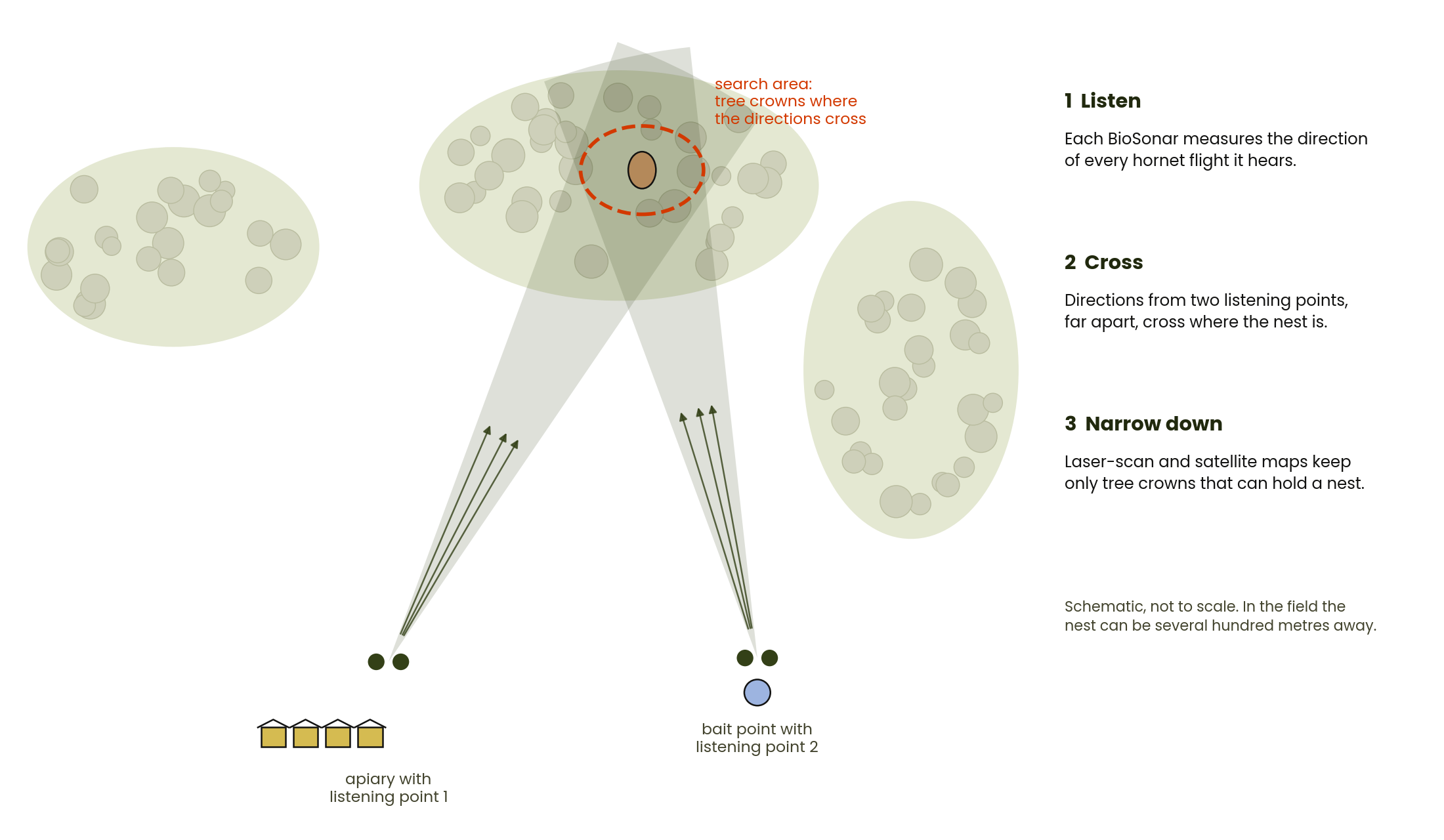
The classic way to find a nest is slow. A beekeeper watches a hornet leave a bait, notes the direction with a compass, walks to a second point and does it again. Where the two directions cross, the nest should be. BioSonar does the same thing with sound, for every hornet, all day.
2. How to find an Asian hornet nest by sound
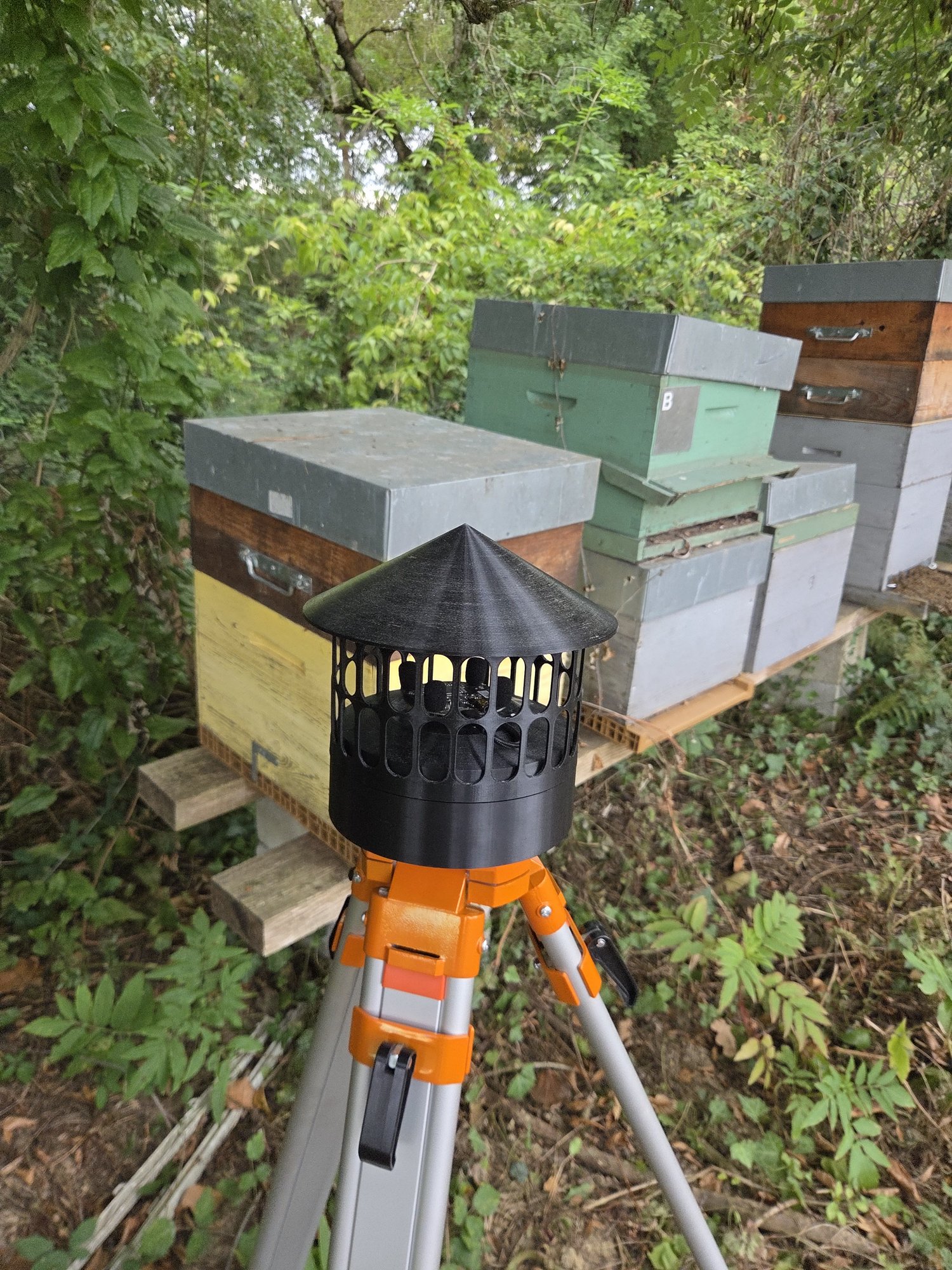
BioSonar is the acoustic sensor we tested this spring in a blueberry field. It has four microphones and a small computer. Every 64 milliseconds it measures the pitch of the sound around it and the direction the sound came from. The direction comes from the very small delay between the sound reaching each microphone. The sensor sends out only these measurements, not the audio.
A hornet sounds different from a bee. Its wings beat slower, so its flight tone sits around 125 Hz, while a honeybee flies at about 200 to 250 Hz. That difference lets the sensor separate the two.
To find a nest, we set up two listening points some distance apart. One stands at the apiary, where the hornets hunt. The other can stand at a bait point, which pulls hornets to a second place we choose. A hornet that has fed flies straight home, so over hundreds of flights the directions from each listening point line up with the nest. Where the two lines cross, we search. The further apart the listening points, the sharper the crossing.
The last step uses maps. The French national laser scan (IGN LiDAR HD) gives the height of every tree at half-metre resolution, and satellite land cover (ESA WorldCover) shows woods, fields and buildings. A nest needs a tree crown, so we keep only the crowns along the flight directions that are tall enough to hold one.
We call this approach Biological Intelligence. The animals do the hard part. The hornets know where their nest is and fly to it hundreds of times a day. Our sensors listen, and our models turn the sound into a place on a map.
3. Four days with BioSonar in the Landes
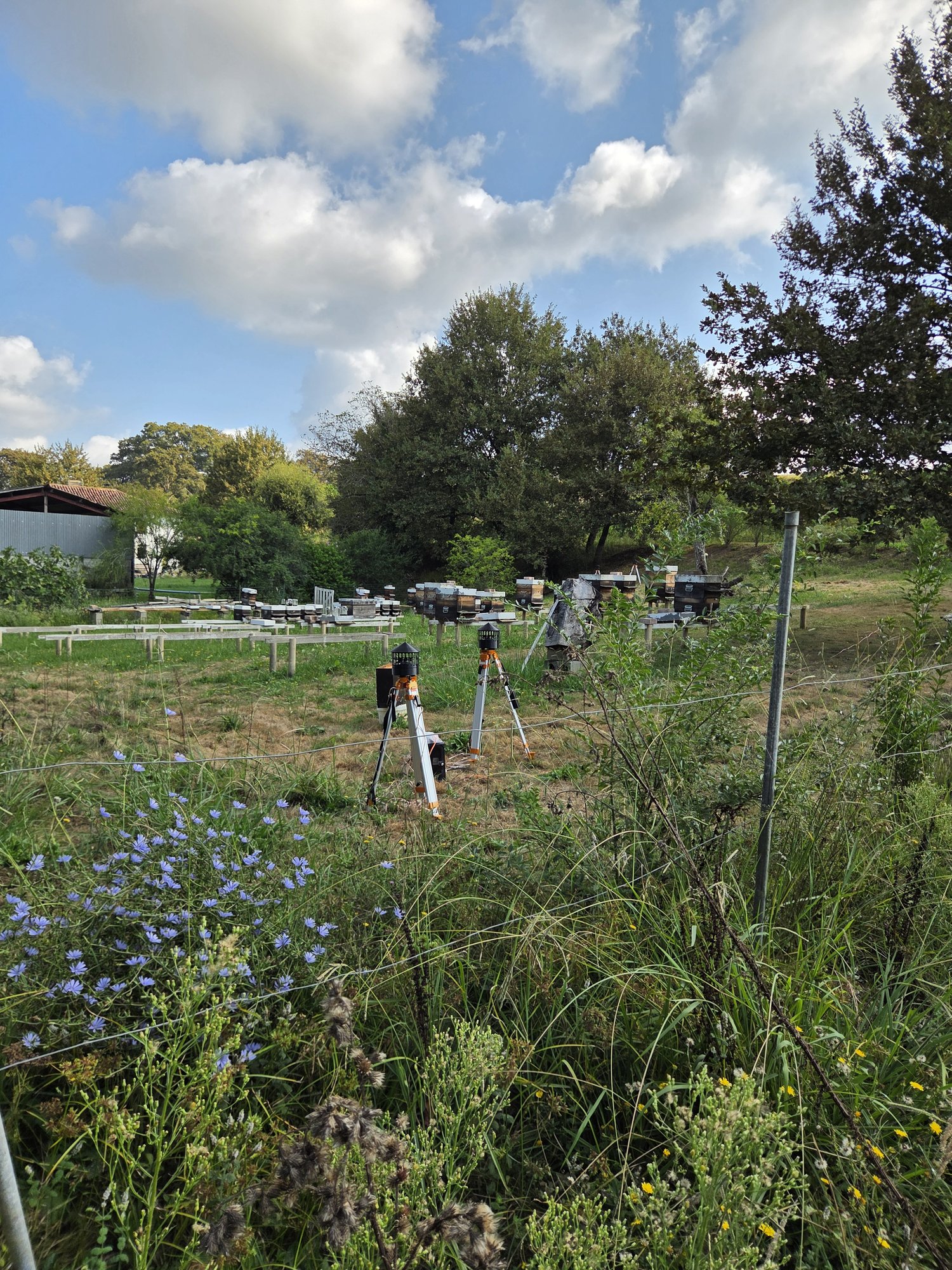
The Landes, between Bordeaux and the Pyrenees, lies in the part of France where the Asian hornet first settled in Europe. Three local beekeepers hosted us, together with a hornet-control specialist who finds and destroys nests in the area. On the first day we walked each plot with them and agreed together where the sensors would stand.
We drove down with 13 sensors on tripods. Each apiary got two listening points, tens of metres apart, each with two or three sensors a metre apart, all powered by one garden cable from the nearest socket. A full site used 12 to 15 W, about as much as one LED bulb. Before recording we calibrated every sensor with a small speaker that played a steady tone from a known position. That tells each sensor which way north is.
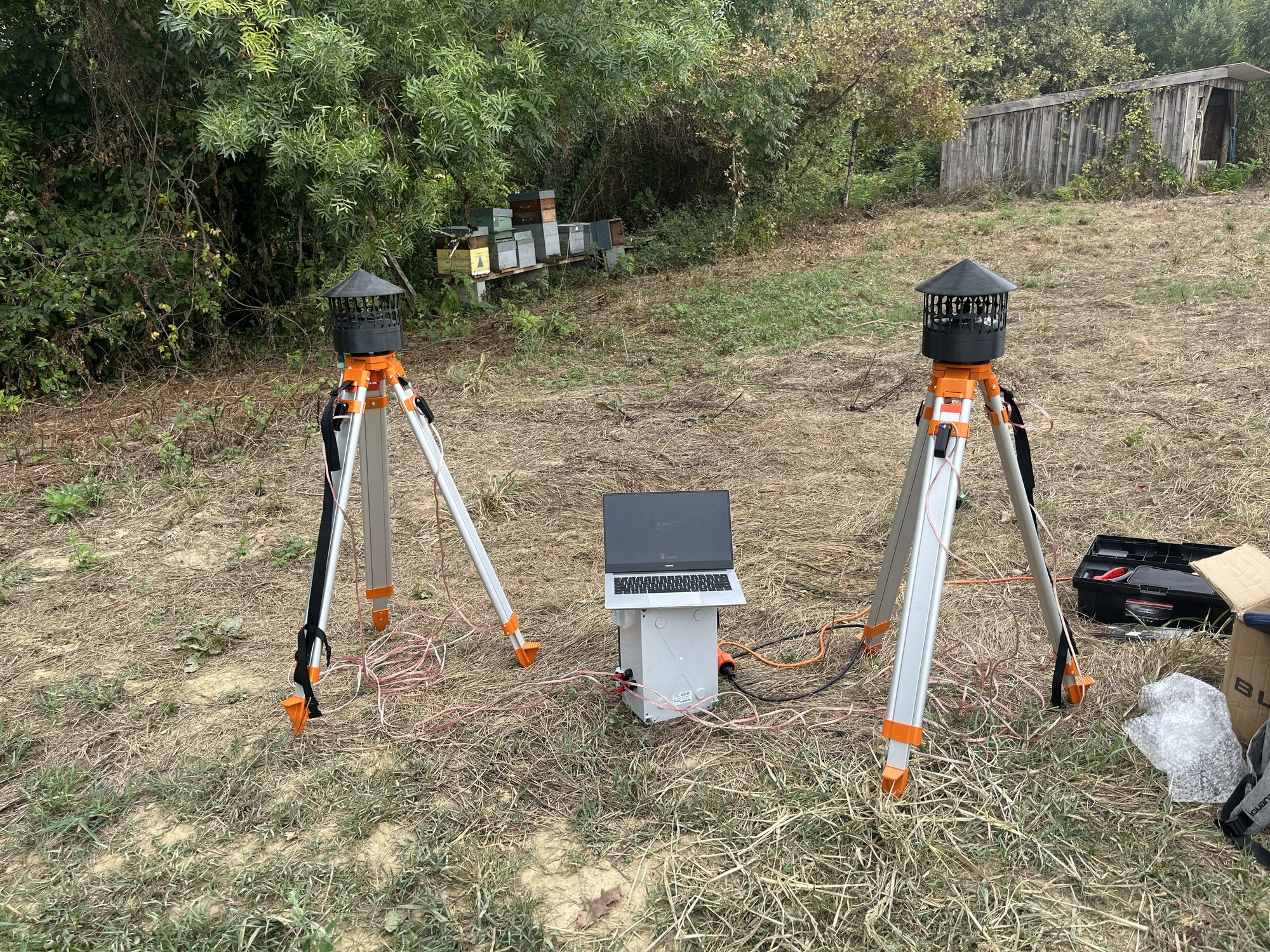
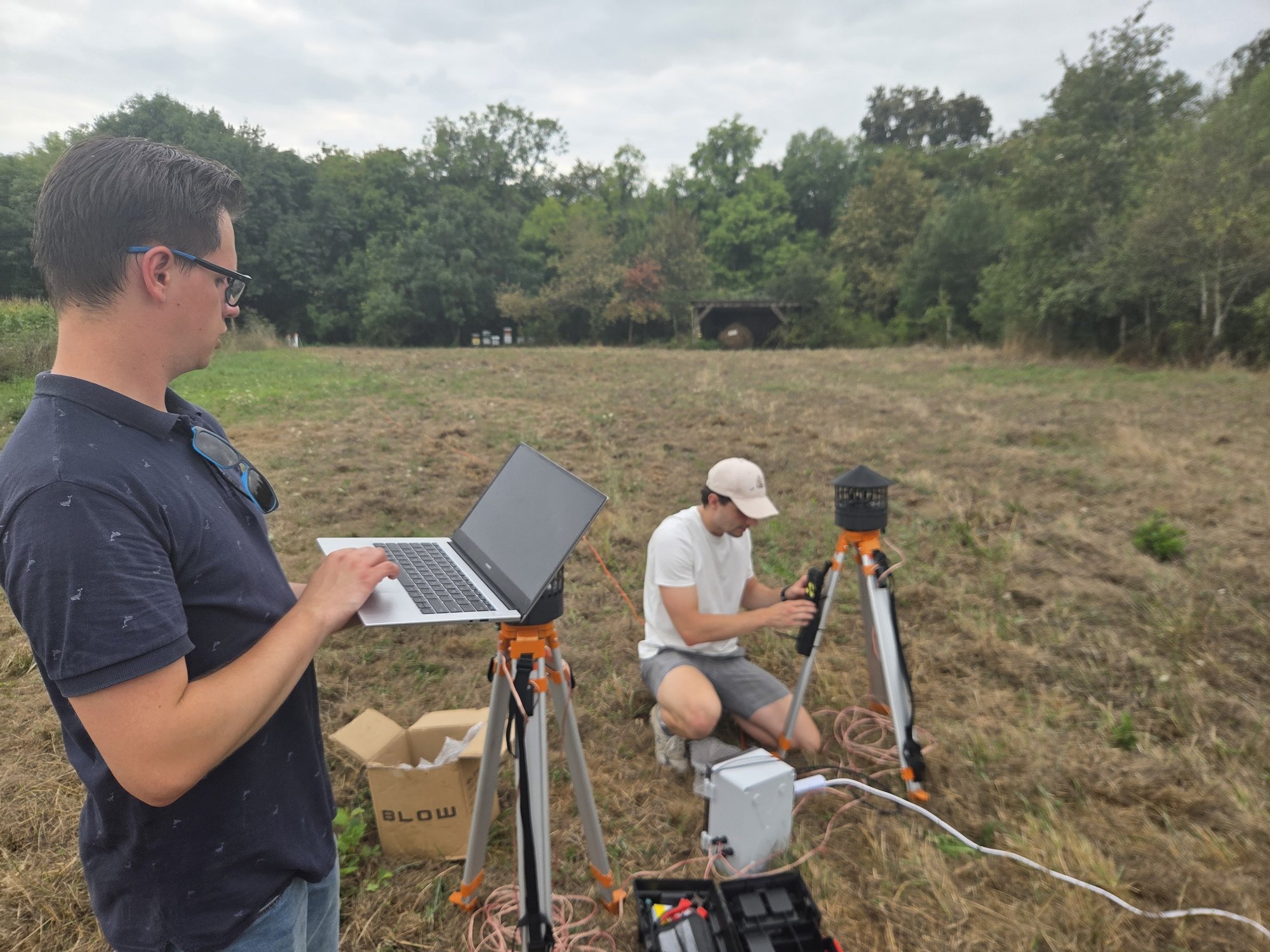
The sensors recorded between 16 and 20 August. We checked them every day over Wi-Fi from a laptop, without opening anything or disturbing the bees. At one apiary a voice recorder ran next to two sensors for 70 hours, so that we can listen to the raw sound behind any measurement later.
4. Results: hornet flight directions at three apiaries
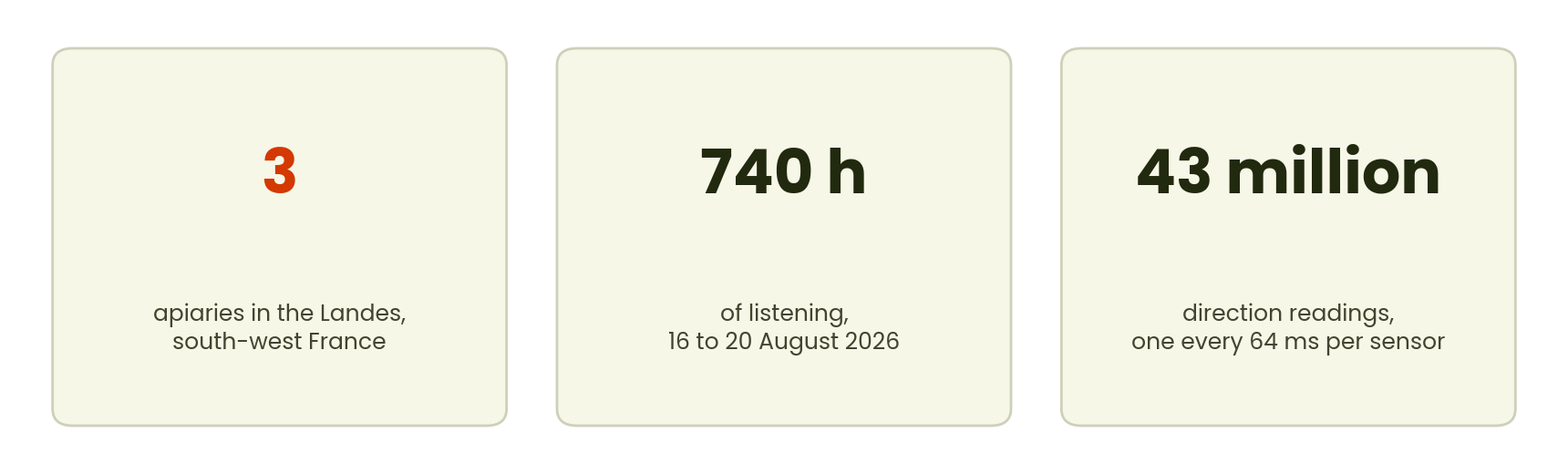
All 13 sensors recorded. Together they listened for 740 hours and wrote 43 million direction readings, 14.3 GB of measurements. Almost all of the sound events that passed the filter, 98 percent, fell between five in the morning and ten at night. The nights were quiet, as they should be for an insect that flies by day.
Eight days after we packed up, each beekeeper got a map of their surroundings. It showed the main flight directions from the apiary and the candidate search areas along them, 18 areas in total, all within one kilometre of the three apiaries.

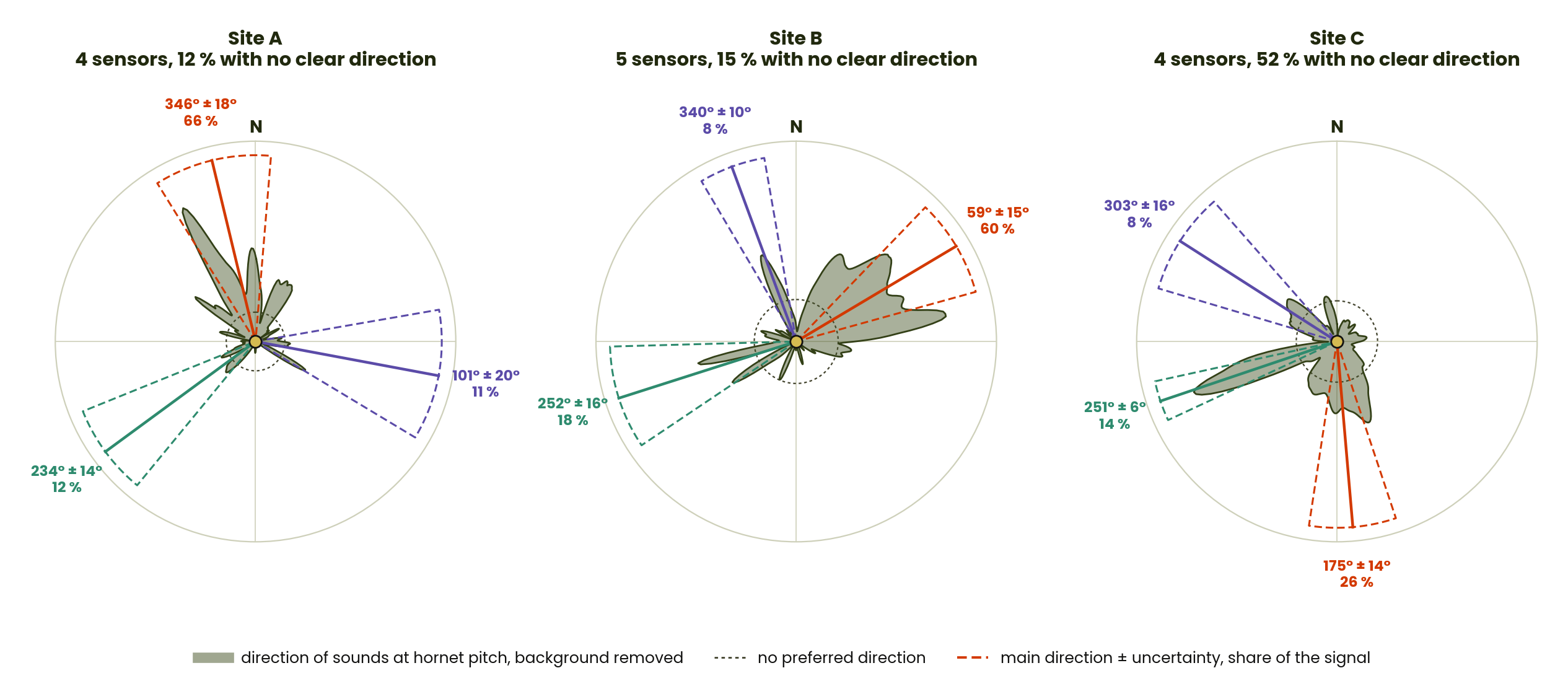
Each apiary had its own pattern. At Site A the hornets used two clear directions, one to the north-west and one to the north-east. At Site B they split three ways, and at Site C four. A search area is long and narrow for a reason. The sensors measure the direction of a flight well, but the distance to the nest much less well, so each area stretches along its direction.
Since August we have refined the analysis. The chart below pools all sensors at each apiary, removes the background noise, and fits a statistical model that splits the remaining signal into a few main directions plus a part with no clear direction. Sites A and B each show one strong main direction that carries about 60 percent of the signal. At Site C half of the signal has no clear direction, so we treat its directions with more caution. These refined directions are the ones we now compare with the nests found in the field.
5. Did the directions lead to nests? Validation is under way
A field pilot ends when the sensors come home. The validation takes longer. The beekeepers and the hornet specialist are checking the search areas on the ground and sending us the position of every nest they find and destroy. The first feedback is encouraging. According to our hosts, the nests found near two of the apiaries this autumn lay in flight directions the system had marked. We are now checking each of these finds against our own measurements, one by one. The hosts will send their final field report in November, after the leaves fall and the nests become easier to see.
The four days also showed us what to change. We wrote down three things.
- The microphone head of the first BioSonar was built for bees. It catches only the higher overtones of hornet flight, between 500 Hz and 1 kHz, so it hears a hornet only within about four metres.
- Wind, and anything that touches the housing, can make a sound that looks like flight. We learned to check each event against a neighbouring sensor a metre away. If the neighbour heard nothing, it was not a hornet in the air.
- The prototype is not weatherproof, so we planned every visit around the rain forecast.
6. The next BioSonar hears the hornet's own flight tone
All three points lead to the same place, a new microphone head. We are already testing it. On 11 October we took the next BioSonar prototype into a field next to a busy road and played the flight sound of a hornet and of a bee from a speaker that circled the sensor.
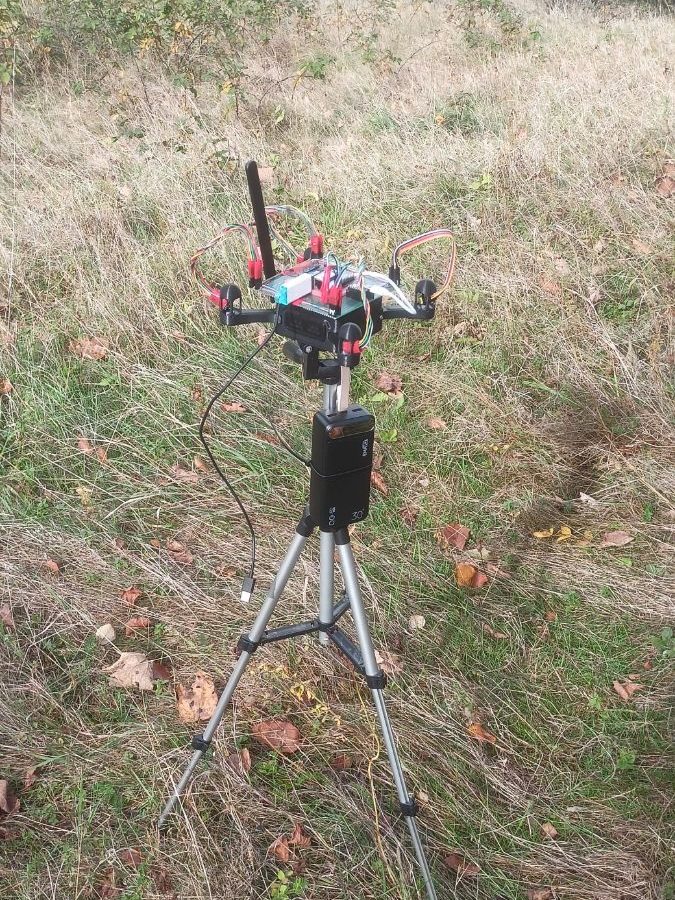
The new array is 22 cm across instead of 6.5 cm, and it hears the hornet's own flight tone at about 125 Hz, not only the overtones. It has separate filters for hornets (100 to 180 Hz) and bees (180 to 300 Hz). The sensor followed the speaker through every circle, and it held the right direction, mostly to within 10 degrees, on all four sides, with road noise and gusts of wind in the background.
Optimising the whole system around the new BioSonar is work for the next season and the next pilot. The plan is a longer deployment, from the first hornets at the hives in summer to leaf fall, with weatherproof sensors, a trained hornet detector in place of hand-set filters, and listening points further apart. We plan new tests in Belgium and Germany. If the hornet settles in Poland next spring, we want Polish apiaries in that pilot too.
7. Can the hive tell us about hornet stress? A hypothesis
There is a second dataset from this summer. Apisense VitalSensors went into colonies at the French apiaries and stay there after the pilot. They track conditions inside the hive, all season.
For this season we now have both sides of the story. We know from the VitalSensors how the colonies behaved, and we know from BioSonar when hornets hunted at the entrance. Our hypothesis is that hornet pressure leaves a mark in the in-hive signals. If it does, a model trained on these paired data could recognise hornet stress from VitalSensor data alone, at apiaries where no BioSonar stands.
We have not tested this yet. It is the next analysis on our list, and we will report the result whether it holds or not.
8. How to recognise the Asian hornet
Many photos of a "hornet" posted online show a wasp or the native European hornet. The Asian hornet (Vespa velutina, also called the yellow-legged hornet) is easy to tell apart once you know what to look for.
- The body is dark, almost black. The abdomen has one wide yellow-orange band on the fourth segment, and the other segments have only thin yellow edges.
- The legs are dark with yellow ends, which gives the species its other name.
- The face is orange-yellow and the top of the head is black.

The European hornet (Vespa crabro) is larger and looks lighter. Its face is yellow and the back of its head reddish brown, its thorax is dark with reddish-brown marks, its abdomen is mostly yellow with black marks, and its legs are brown. Behaviour also helps. Asian hornets hover in front of a hive, facing the entrance, and wait for returning foragers. Several hornets doing this at the same hive is a strong sign. A large Asian hornet nest is round or pear-shaped, often high in a tree crown, with the entrance on the side. The European hornet usually nests in a cavity, such as a hollow tree, a shed or an attic.
9. Asian hornet in Poland: what beekeepers can do now
The nest near Kraków is gone, but scientists assume its young queens had already left. Next spring and summer will show whether the hornet stays in Poland, when new nests appear in the tree crowns. Until then, three things help most. If you see an insect that could be an Asian hornet, take a photo from a safe distance and report it to your municipal office and the Regional Directorate for Environmental Protection (RDOŚ), or post the photo on iNaturalist. Do not go near a nest or try to remove it yourself, because trained services do that. And do not kill wasps, European hornets or bumblebees in panic, or put traps at the apiary that catch every insect.
BioSonar will not replace the beekeeper who walks the tree lines with a compass. It is meant to tell that beekeeper which tree line to walk first.
10. Conclusion
Four days, three apiaries, 13 sensors. The prototypes worked through a French August, the data came home complete, and the beekeepers got maps with search areas eight days later. Those areas are now being checked on the ground. The next BioSonar is already in testing, and the next pilot will run it for a full season.
If you keep bees in an area with Asian hornets, in France, Belgium, Germany or, from next year, Poland, and would host a BioSonar, or if you research Vespa velutina and want to help design the next pilot, contact us through the contact page.
References
- PAP (2026). Niebezpieczny szerszeń azjatycki wykryty w Polsce. Rzeczpospolita, 16 October 2026. https://www.rp.pl/nauka/art45344891-niebezpieczny-szerszen-azjatycki-wykryty-w-polsce-zjada-pszczoly-miodne
- Polsat News (2026). Szerszeń żółtonogi już w Polsce. Pod Krakowem odkryto pierwsze gniazdo. 16 October 2026. https://www.polsatnews.pl/wiadomosc/2026-10-16/szerszen-zoltonogi-juz-w-polsce-pod-krakowem-odkryto-pierwsze-gniazdo/
- M jak Małopolska (2026). Pierwsze w Polsce gniazdo szerszenia azjatyckiego zlikwidowane pod Krakowem. Specjaliści apelują o czujność. 20 October 2026. https://www.mjakmalopolska.pl/artykul/10218,pierwsze-w-polsce-gniazdo-szerszenia-azjatyckiego-zlikwidowane-pod-krakowem-specjalisci-apeluja-o-czujnosc
- PAP (2026). Zlikwidowano pierwsze w Polsce gniazdo szerszenia azjatyckiego. 27 October 2026. https://nauka.wiara.pl/doc/9942094.Zlikwidowano-pierwsze-w-Polsce-gniazdo-szerszenia-azjatyckiego
- Monceau, Bonnard and Thiéry (2014). Vespa velutina: a new invasive predator of honeybees in Europe. Journal of Pest Science 87:1-16. https://doi.org/10.1007/s10340-013-0537-3
- IGN (2026). LiDAR HD, national laser scan of France. https://geoservices.ign.fr/lidarhd
- ESA WorldCover, global land cover at 10 m. https://esa-worldcover.org