
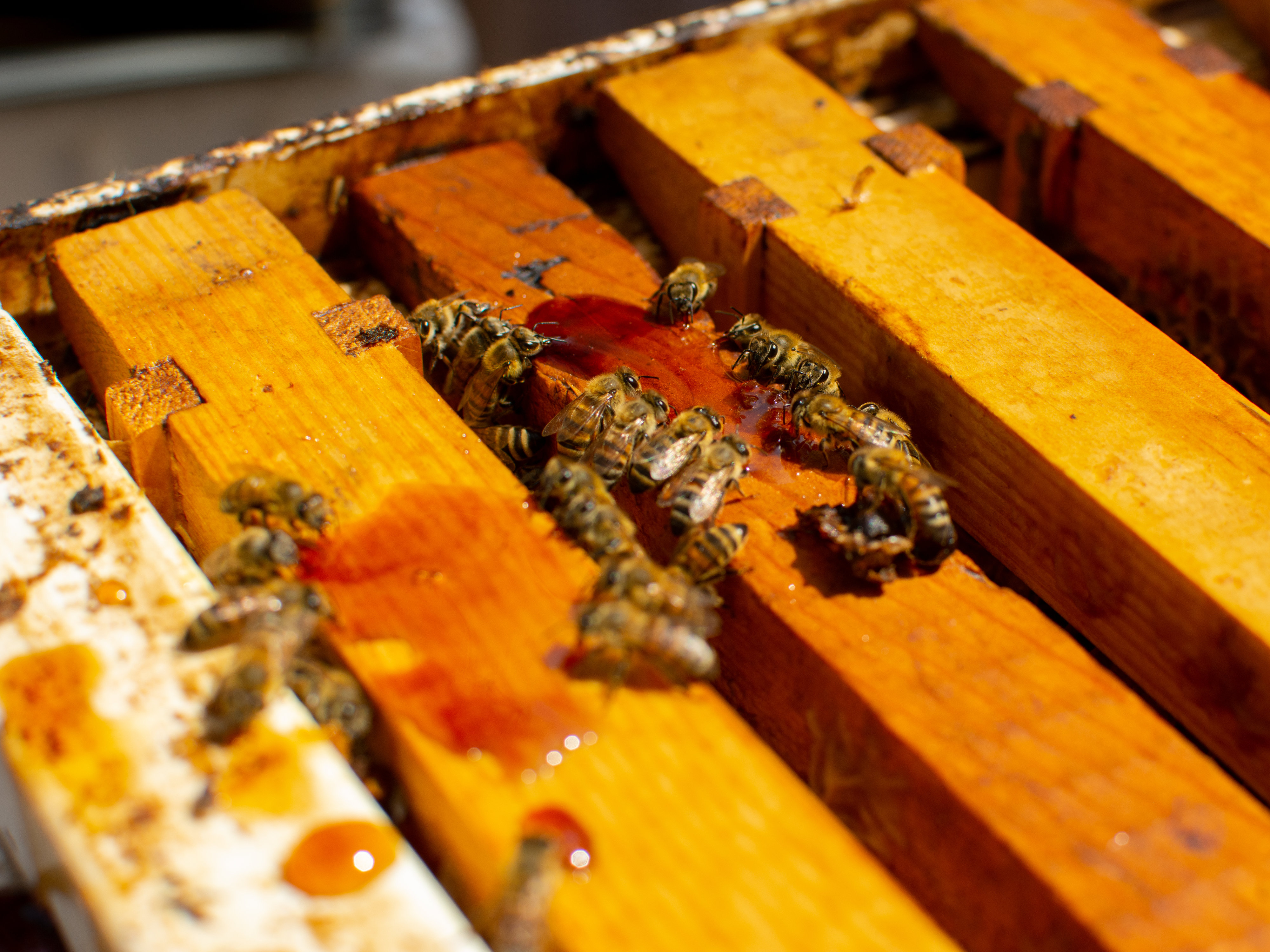
Honey Intelligence: The hive that knows when its honey is ready
Honey Intelligence reads a beehive's weight and the air it breathes out, and tells you three things: nectar is coming in, the honey is ripening, or it is time to check the capping. For the first time you can follow it day by day, without opening the hive.
1. Honey is water leaving a box
Nectar is mostly water, often 60 to 80 percent. Honey is under 18 percent. Everything in between is work the bees do: they pass each droplet from mouth to mouth, spread it thin across the comb, and fan it for days until enough water has gone that no yeast can live in it. Only then do they cap the cell. Put plainly, for every kilogram of nectar that comes in, the colony has to throw out something like half a kilogram of water before it can call the rest honey.
That is why moisture is the whole story of ripening. Honey that is capped too early, or taken too early, ferments in the jar, and no amount of filtering fixes it. Beekeepers have always judged it the only way they could: by eye, from the cappings, on a frame pulled out of an open hive. The water itself was never measured, because it leaves as air, and air was invisible.
It is not invisible to a sensor. The water the bees fan out of the entrance makes the hive's air measurably wetter than the air outside. We already measure humidity in two places: the VitalSensor inside the hive and the climate sensor built into the Scale beneath it. Subtract one from the other and you get the water the colony is pushing out, in grams per cubic metre, every hour, without lifting a lid. That number has a rhythm, and the rhythm is the honey.
While nectar flows in, the scale gains weight every day and the evaporation is high. When the flow stops, the weight goes flat, but the evaporation stays up for a week or two: the bees are still drying what they have. Then it sinks back to the hive's own baseline. The drying is done.
So a hive's season reads as three states:
- Flow. Weight rising, nectar still coming in. Do not harvest, give the colony space.
- Ripening. Weight flat, water still leaving. The honey is there, but it may be wet.
- Ready. Evaporation back at baseline. Go and check the capping.
That last phrase is the actual wording in the app: "Check the capping. With about two thirds of the frame capped you can harvest." Honey Intelligence never says "the honey is ready" and never quotes a moisture percentage, because it does not measure one. Ripeness is confirmed by your eyes on a capped frame. What the system does is tell you which hives are worth opening this weekend, and while a hive is ripening it estimates how many days are left, from the speed at which the evaporation is falling: "may be ready within 3 days", never a date carved in stone.
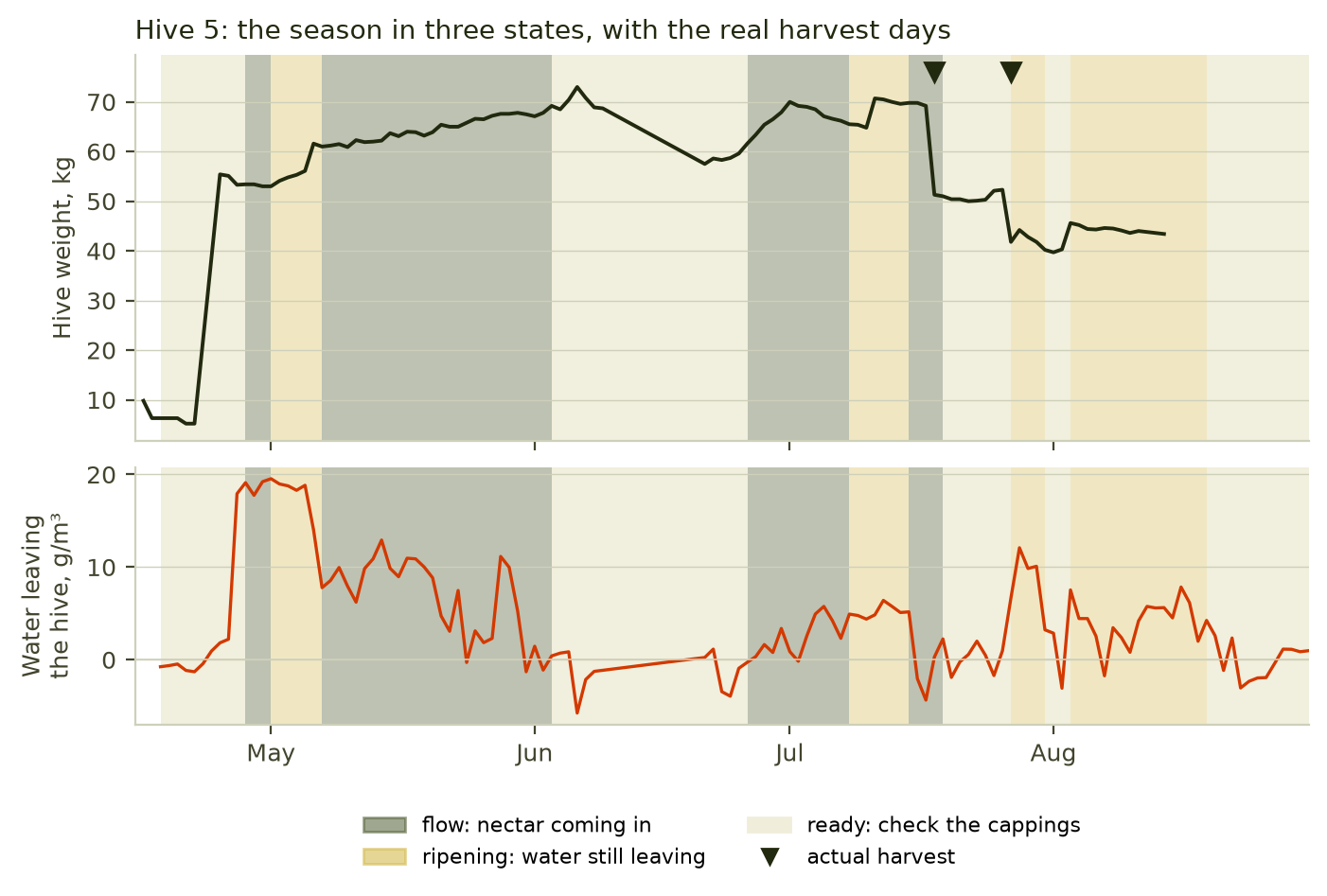
said each day; the black triangles are the days our beekeepers actually harvested. Both came while the hive read
"ready".
2. Did it match what real beekeepers did?
We checked the signal against 18 harvests on Chocznia hives that had both a sensor and a scale. In 12 of the 18, our beekeepers took the honey while the hive read "ready". They were not looking at this chart. They were opening hives and reading cappings, the old way, and without knowing it they harvested when the air said the drying had finished. The other six were early-June harvests taken on purpose during a running flow, to keep a monofloral crop separate, and the system reported them honestly as "flow".
On this season a hive spent a median of 8 days in ripening before it turned ready. Some took two weeks. That gap is exactly what a beekeeper with thirty hives and one free weekend wants to know.
3. The diary that writes itself
Every beekeeper keeps a harvest diary, and most keep it badly, because a harvest day is twelve hours of lifting, smoke and stings. A scale should fix this, but a beehive on a scale is a terrible witness. A strong colony gains 5 kg in a day and loses part of it overnight as the bees dry the nectar. Rain adds weight to the roof. The beekeeper lifts the hive off for an inspection and puts it back forty minutes later.
Honey Intelligence reads the scale the way an experienced beekeeper would. One number per day, the daily median. Then it watches for steps: changes too large to be biology. When it sees one it does not guess. It waits to see whether the new level holds. A hive lifted and put back is filed as "inspection, nothing happened". A weight that steps down and stays down is a harvest. A weight that steps up and stays up is a super added, or feed. Three fingerprints, and everything a beekeeper does to a hive leaves one of them.
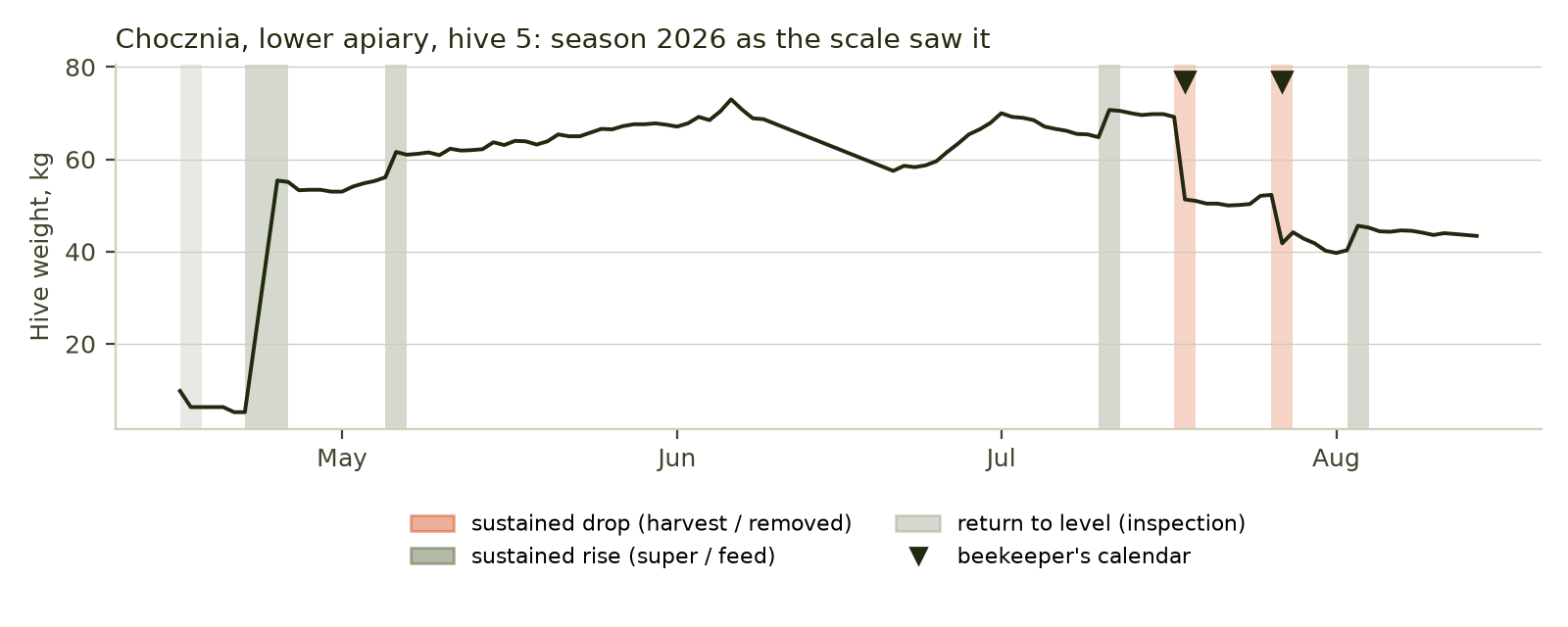
triangle is one our beekeepers wrote down. Where they line up, machine and human agree.
4. The test: 17 hives, 31 events, one handwritten calendar
The rules were fixed before we looked at the answers. The detector got the raw scale data from 17 hives across three sites in Chocznia, mid-April to mid-August, and nothing else. Separately, our beekeepers' calendar listed 31 events, harvests and additions, each with a date and a kilogram estimate.
The detector found 30 of the 31 and named them correctly. Of those 30, 27 came within 15 percent of the beekeeper's own estimate. Summed over the whole apiary and the whole season, the scale counted 215 kg of honey taken. The calendar said 217 kg. Ninety-nine percent of the season's honey, accounted for by a scale, without anyone writing anything down.
The one miss: on 20 May a colony was fed 5.4 kg of syrup in two portions on two days, and each portion looked like a good day of nectar. We could tune for it, but every notch of extra sensitivity costs about ten more "was this you?" questions a season. Ambiguous cases go to the beekeeper instead.
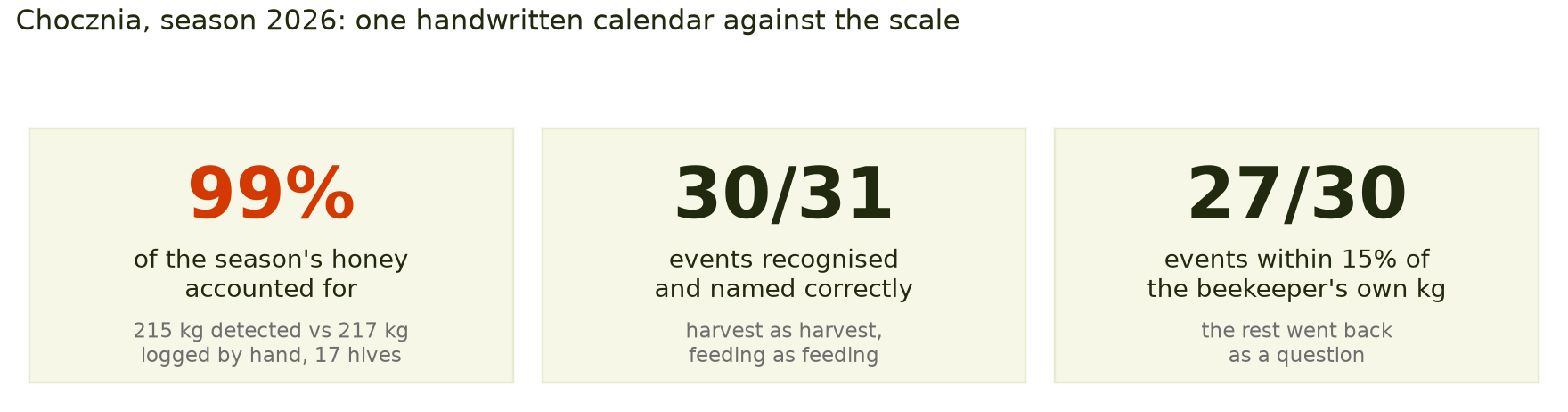
scale alone; 30 of 31 events were named correctly; 27 of them within 15 percent of the beekeeper's own estimate.
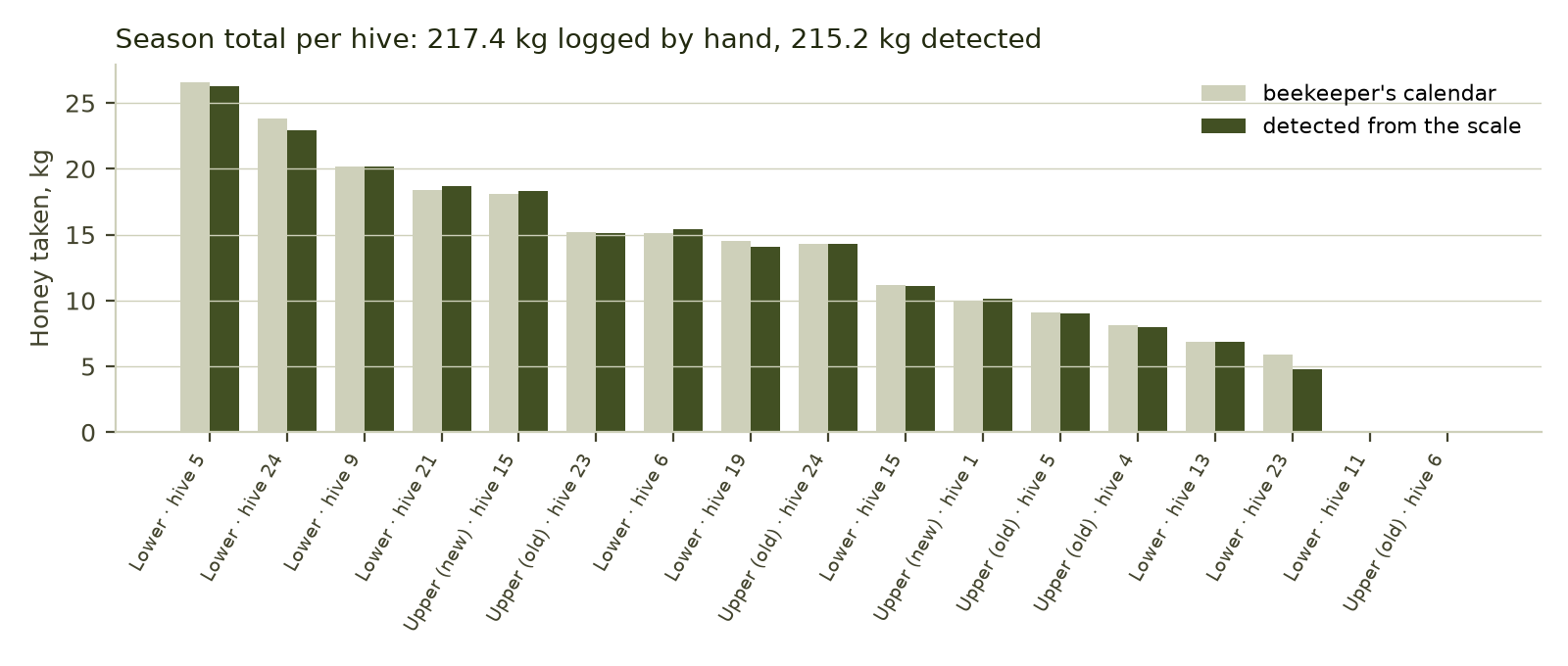
detected drop and no calendar entry are the ones the app would have asked about.
5. Hive 13
On 8 June, hive 13 gained 19.5 kg overnight. Two days later, on the day the whole apiary was harvested, it lost 27.7 kg. The calendar has nothing for hive 13 on either day.
We think someone added a full super, then took the boxes off with the rest of the apiary, and in the rush of a harvest day nobody wrote it down. But we are not certain, and neither is the detector. So it does not silently add 27.7 kg to hive 13. It flags an unresolved event and asks.
Across the season it raised 31 such questions for events the calendar never recorded. One cluster stands out: on the night of 2 to 3 August four hives gained weight at the same time. Four synchronised jumps in one apiary is not nectar. It is a beekeeper with a bucket of syrup. You still keep a diary. But the first draft is now written by the hive, and your job is to confirm or correct, one tap at a time.
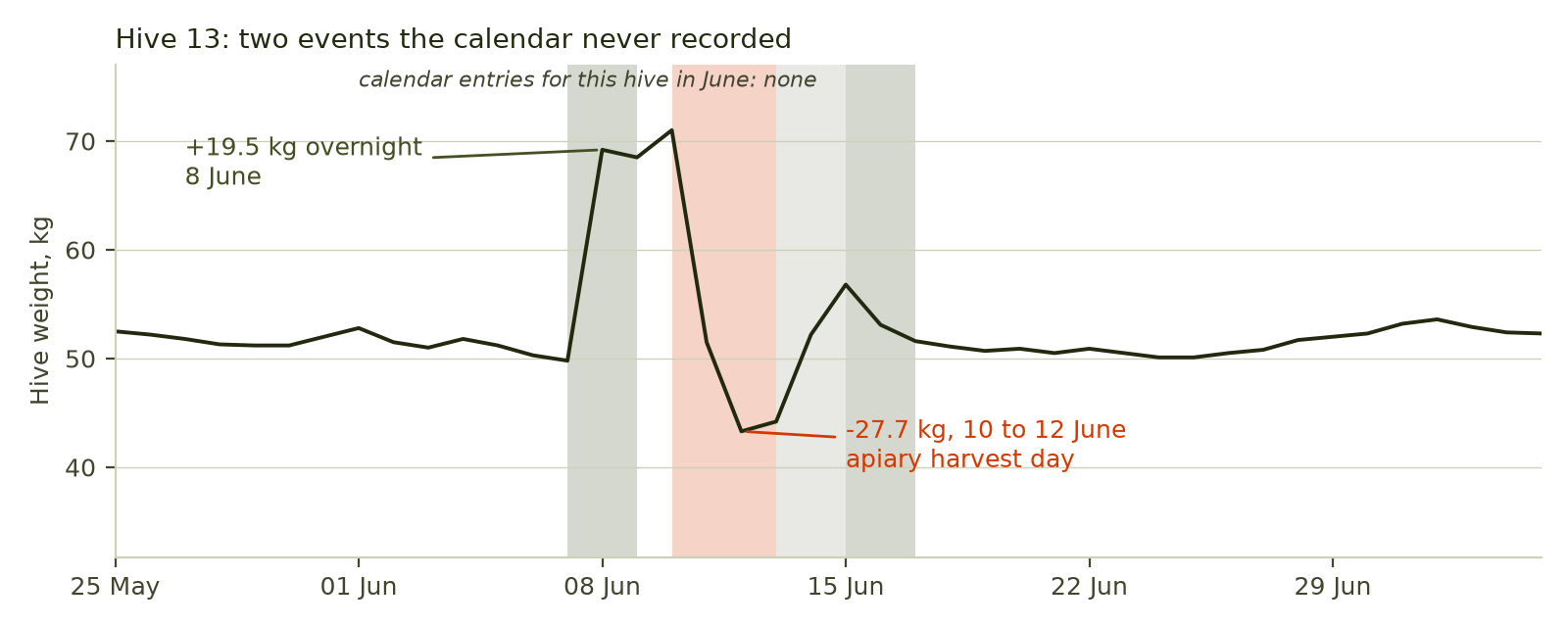
app turns into a question.
6. Not just our apiary
A method tuned on one apiary can learn that apiary's habits, so we pointed the finished system, unchanged, at a single scale in Świnna, a private apiary run by one of our engineers that played no part in tuning and had no calendar at all. It told the same story: the two June drops fell in a "ready" band, exactly the sequence we saw in Chocznia, and the two August drops fell in "ripening", with a note that whatever came off might still be wet. Same rules, different hives, same behaviour.
7. What you see in the app
Honey Intelligence is live in the Apisense app. With a Scale under the hive you get its events, harvests, additions, feedings and inspections, recognised from the weight alone, and a season total you never had to type. Where the scale is not sure, it asks. With a VitalSensor as well, you get the timeline: flow, ripening, ready, with days-to-go while it ripens and the reminder to check the capping when it gets there.
At the apiary level this meets the weather. The work advice already says whether the day is fit for a harvest. Now it also knows whether there is honey to take: it tells you which hives are ready and how many, and suggests the harvest day the weather allows. And because a scale cannot tell autumn syrup from a late flow, the app only ever suggests a harvest inside the honey season for your country, so a colony being fed for winter never reads as honey to take.
8. Where this goes
In European conditions the system works. One season, one apiary, one outside check, and the result is 99 percent of the honey accounted for and 30 of 31 events named correctly. We run hives on six continents, so the next job is making sure it works everywhere else: record nectar days in other climates, different feeding habits, different bees. The thresholds keep learning as more hives report in, and the system will keep asking you to look at the frame before it lets you believe a number.
Honey is the headline, but the same scale keeps watching after the last harvest. Through winter it sees the stores go down, week by week, without a single lid lifted. Reading that curve, and turning it into "this colony is eating faster than its neighbours, look at it", is the next thing we are teaching Honey Intelligence.
The question used to be whether the honey is ready today. Now it is how much of the process that makes it ready we can read from outside the box, and this season's answer is: most of it. We have found the way to read it. What is left is proving it, hive by hive, in every climate where our scales already stand.
9. Conclusion
Bees have been drying nectar and capping honey for millions of years, and they have been telling anyone who cared to listen exactly where they are in that work: in the weight of the box and in the water they fan out of it. The hive did not learn anything new this summer. We did. At Apisense we learned to read that signal, we checked our reading against a season of real harvests, and it held. Now we are putting it in the hands of every be