

What hive temperature tells you about a honey bee colony
Two sensors in the same hive can disagree by twenty degrees, and both are right. How honey bees heat and cool their nest, what a few degrees cost the brood, how swarming and the winter cluster show up in hive temperature data, and why reading colony health takes more than one thermometer.
Two sensors in the same hive, at the same moment, can disagree by twenty degrees, and both are right. Temperature within a honey bee colony is far from uniform, and measurements taken simultaneously at different locations can reveal substantial thermal differences.
The honey bee (Apis mellifera) colony, rather than the individual worker, is the primary functional unit of thermoregulation. Individual honey bees are small insects whose body temperature is strongly influenced by ambient conditions, but they can generate metabolic heat by activating their thoracic flight muscles, even without flying (Heinrich, 1979; Stabentheiner et al., 2010). At the colony level, the coordinated physiological and behavioural responses of many workers keep the brood nest at relatively stable temperatures, typically around 34 to 36 °C, despite fluctuations in external conditions (Kleinhenz et al., 2003; Stabentheiner et al., 2021).
A temperature sensor does not measure whether a colony is “healthy” or “sick”. It measures the thermal conditions at a specific location within a complex, living system. To understand what a reading means, we first need to understand why honey bees regulate temperature, how this regulation changes through the season and, perhaps most importantly, how similar temperature patterns can arise from entirely different biological processes. Collecting data is becoming relatively straightforward. Translating raw measurements into meaningful biological interpretations of colony activity remains considerably harder. This is one of the central challenges of precision beekeeping.
The honey bee colony as a superorganism
The honey bee colony is often described as a superorganism, a highly organised biological system in which thousands of individuals function as an integrated unit rather than as independent organisms (Seeley, 1989; Hölldobler & Wilson, 2009). This organisation rests on division of labour, communication and coordinated behavioural responses, allowing the colony to perform functions beyond the capabilities of individual bees. One of the most remarkable consequences of this social organisation is the ability to maintain internal homeostasis despite fluctuations in environmental conditions.
Temperature regulation is a particularly clear example of how the superorganism functions. Unlike individual bees, whose body temperature varies considerably, the colony can collectively regulate the thermal conditions within the nest, particularly in the brood area. It does so through coordinated behaviours, including heat production, clustering, ventilation and evaporative cooling, which allow it to respond dynamically to changing conditions (Stabentheiner et al., 2010, 2021). An appropriate thermal environment is essential for brood development, metabolic processes and overall colony functioning.
How bees heat and cool the hive
Honey bee colonies maintain thermal homeostasis through two complementary processes: active heat production and cooling. In cold conditions, workers form compact clusters that reduce heat loss, with more individuals in the cluster core, where their activity helps maintain internal temperatures (Stabentheiner et al., 2003). Within the brood nest, nurse bees transfer heat directly to developing brood (Bujok et al., 2002; Kleinhenz et al., 2003). These mechanisms allow colonies to regulate brood temperature even when ambient conditions are unfavourable.
Cooling, in contrast, relies primarily on coordinated wing fanning and evaporative cooling. When nest temperature rises, workers increase airflow through the hive, often by fanning their wings at the hive entrance, and spread collected water across nest surfaces, so that heat dissipates through evaporation (Stabentheiner et al., 2021). Wing fanning also ventilates the hive and evaporates excess water from nectar during honey ripening. Thermal stability therefore reflects not only the number of workers but also their coordinated responses to changing conditions and the genetic diversity of the workforce (Jones et al., 2004).
Brood temperature: what the set point buys, and what a few degrees cost
Holding 35 °C is expensive, so it must be worth something. Pupae reared at 32, 34.5 and 36 °C produce adults that differ in behaviour, with bees from the warmer end dancing more and remembering better (Tautz et al., 2003). The effect reaches into the brain, where synaptic organisation in the adult mushroom bodies depends on the temperature experienced during pupal development (Groh et al., 2004). Bees reared away from the optimum show reduced developmental stability and weaker learning and memory (Jones et al., 2005).
The cost gets sharper when a pathogen is involved. Chilling fifth instar larvae to 18 °C for 24 hours before the cells are sealed, and then holding them at 25 °C, produces chalkbrood in Apis mellifera with mummification rates close to 95 percent (Flores et al., 1996). Ascosphaera apis grows in culture across roughly 22 to 37 °C with an optimum near 30 °C (Mráz et al., 2021), which is to say the fungus does best exactly where a colony that has lost thermal control ends up. The histological damage it causes in the larva has since been described in detail (von Knoblauch et al., 2024). Chilling is not merely correlated with chalkbrood. In the experimental literature it is the trigger.
When hive temperature drops: physiological consequences and colony health risks
A decline in hive temperature is often one of the first signals that worries beekeepers who monitor their colonies. Its biological significance, however, depends on the season, the location of the sensor and the physiological state of the colony. A temperature decrease may reflect less brood rearing, seasonal changes in colony organisation or a winter cluster that has moved away from the measuring point. When temperature falls within the brood nest and stays below the range required for normal development, though, the consequences may extend far beyond a temporary disturbance of thermal homeostasis.
From the perspective of colony monitoring, not every temperature decline should be interpreted as a pathological event. In winter, brood rearing may be reduced or temporarily absent, and the colony does not necessarily keep brood-rearing temperatures throughout the nest. In such circumstances, lower readings may reflect normal seasonal physiology rather than impaired thermoregulation. Conversely, persistent changes in the spatial distribution or variability of nest temperature may indicate deteriorating colony conditions. Minaud et al. (2024b), using multiple temperature sensors in overwintering colonies, showed that thermal heterogeneity helped distinguish surviving colonies from those undergoing collapse.
A temperature decline should therefore be evaluated in relation to its duration, magnitude, spatial location and seasonal context. A single low reading does not establish that a colony is diseased or physiologically compromised. Sustained cooling within an active brood area, particularly when accompanied by other signs of colony deterioration, may however provide an early warning of developmental disturbances or an increased risk of disease.
When hive temperature rises: colony development, swarming and heat stress
An increase in hive temperature may indicate several biological processes, from normal colony development to reproductive activity or excessive thermal stress. Unlike a sustained decline in brood-nest temperature, which may raise concerns about the colony’s capacity to maintain suitable developmental conditions, an increase cannot be classified as beneficial or harmful without considering its timing, magnitude and duration. Similar thermal responses may accompany fundamentally different physiological and behavioural events.
One of the most important seasonal changes associated with rising nest temperature is the resumption and intensification of brood rearing. In temperate climates, honey bee colonies typically reduce brood production during winter and progressively resume it as conditions improve. Developing brood requires more stable thermal conditions, so the transition from a broodless to a brood-rearing state shows up in the temperature profile of the nest. Nürnberger et al. (2018) showed that rising ambient temperature can stimulate brood rearing in overwintering colonies, while Stalidzans and Berzonis (2013) showed that long-term temperature measurements can distinguish successive seasonal stages of colony development. A gradual increase followed by relatively stable nest temperatures may therefore reflect the start or expansion of brood rearing rather than an abnormal thermal event.
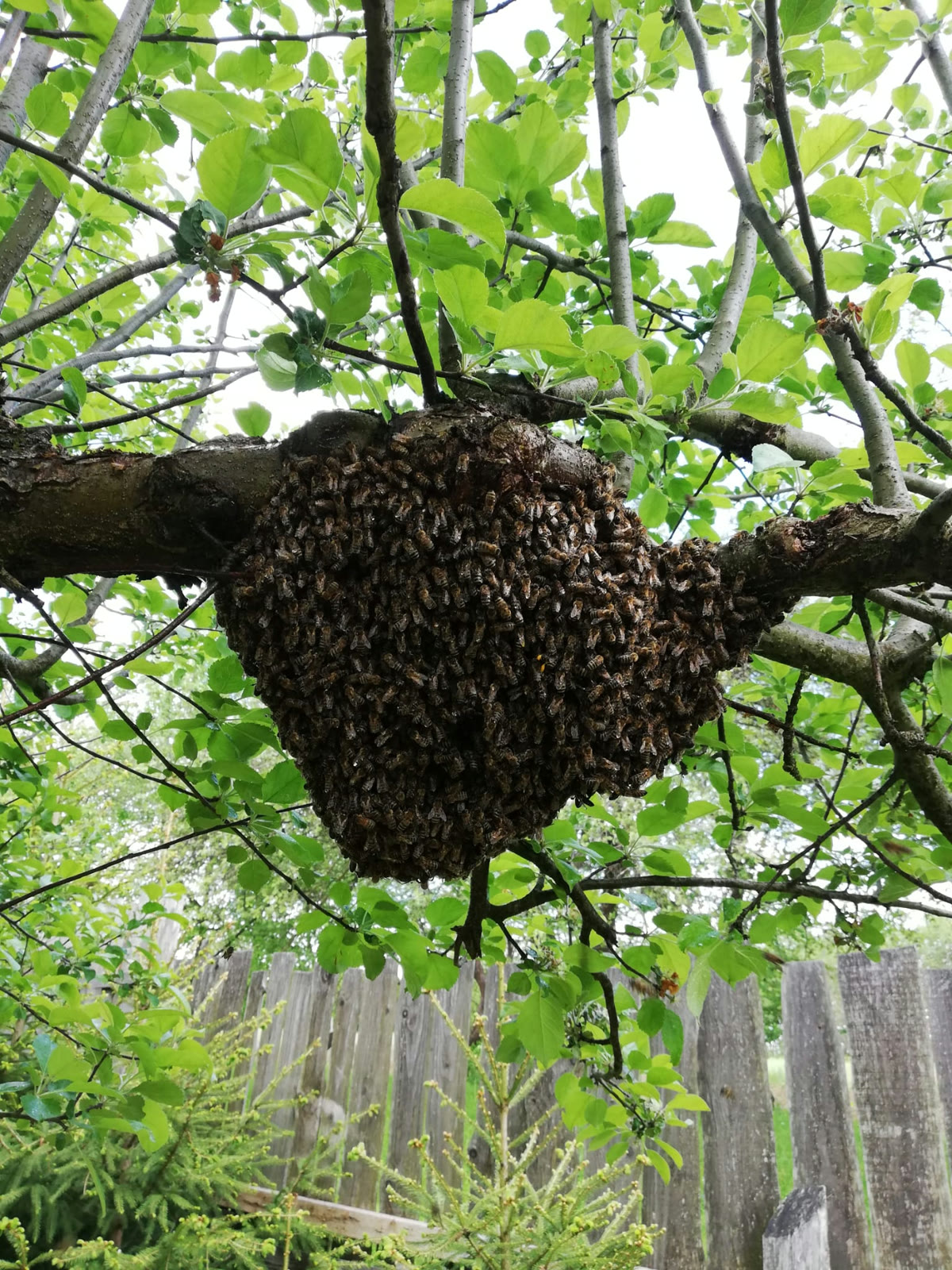
A more rapid and transient temperature increase may be associated with swarming, the natural reproductive process through which a colony divides. Before the swarm departs, increased worker activity and collective preparation for flight may produce a characteristic rise in temperature. Zacepins et al. (2016) monitored ten honey bee colonies and observed temperature increases of about 1.5 to 3.4 °C during the final 8 to 20 minutes before swarm departure. Temperatures measured above the brood nest rose from about 34 to 35 °C to 37 to 38 °C before falling after the swarm had left. Ferrari et al. (2008) also reported an increase in hive temperature accompanied by changes in acoustic activity during the swarming period, which supports combining thermal and sound measurements.
Comparable findings have been reported in the Eastern honey bee (Apis cerana). Zhu et al. (2019) observed a progressive temperature increase before swarming, with an initial heating rate of about 0.069 °C per minute followed by a faster increase of about 0.314 °C per minute. The clearest thermal response was detected at one specific location near the hive entrance, between the hive wall and the first frame. Detecting swarming-related temperature changes therefore depends strongly on sensor placement. A sensor in the brood nest may capture a different thermal pattern from one near the hive entrance or above the upper frames.
Elevated temperatures may also indicate exposure to excessive environmental heat, particularly when cooling mechanisms cannot keep nest conditions suitable. In such circumstances, prolonged thermal stress may interfere with normal physiological processes and activate cellular protective mechanisms. Heat shock proteins (HSPs), including members of the Hsp70 family, play an important role in protecting cellular proteins against temperature-induced damage. Alqarni et al. (2019) found changes in heat shock protein expression in adult honey bee workers exposed experimentally to 40 and 45 °C for four hours. The responses differed between nurse bees and foragers and among honey bee subspecies, suggesting that thermal tolerance and cellular stress responses depend on both physiological role and genetic background.
The biological significance of elevated temperature therefore depends not only on its absolute value but also on exposure duration, developmental stage and the colony’s capacity to dissipate excess heat. Adult workers can show physiological responses that improve their tolerance of high temperatures, but developing brood requires more tightly controlled thermal conditions. Sustained overheating may consequently disturb the developmental environment even when adult workers remain active and the colony initially appears to function normally.
For precision beekeeping, these findings highlight a fundamental limitation of reading increased temperature as a single diagnostic signal. A gradual and sustained rise may indicate that brood rearing has resumed, a rapid transient increase may accompany swarming, and prolonged high temperatures during hot weather may suggest thermal stress. Telling these processes apart requires seasonal patterns, ambient temperature, sensor location and additional measurements, such as humidity, acoustic activity or colony weight. Temperature monitoring is most informative when thermal changes are read as part of a broader physiological and behavioural response rather than as isolated indicators of colony condition.
Where to place a hive temperature sensor
The Zhu et al. study carries a detail that matters for anyone installing sensors. The clearest signal appeared at one specific location, in the bee space between the hive wall and the first frame on the entrance side (Zhu et al., 2019). The best position for catching a swarm is not the best position for watching brood.
Everything above describes a regulated variable. A thermometer in a hive does not measure that variable. It measures the temperature at one point in a spatial field, and how well the two correspond depends entirely on where the point is.
This was understood before electronics made it convenient to ignore. The classic thermology of wintering colonies rested on roughly 1.2 million thermocouple readings from a single full-sized Langstroth hive, because one probe was never going to describe the object (Owens, 1971). Modern work reached the same conclusion with better hardware (Besson et al., 2021; Minaud et al., 2024b).
What one well-placed sensor gives you instead is a time series, and its shape carries most of the information (Meikle & Holst, 2015). Hives worked for commercial pollination enter winter with fewer bees, less brood, lower average temperatures and higher within-day variability than hives on natural forage (Meikle et al., 2017).
How warm is a winter cluster?
In summer the brood nest anchors the thermal field to a known place. In winter that anchor disappears, and the structure the colony forms instead is the hardest case for any monitoring system.
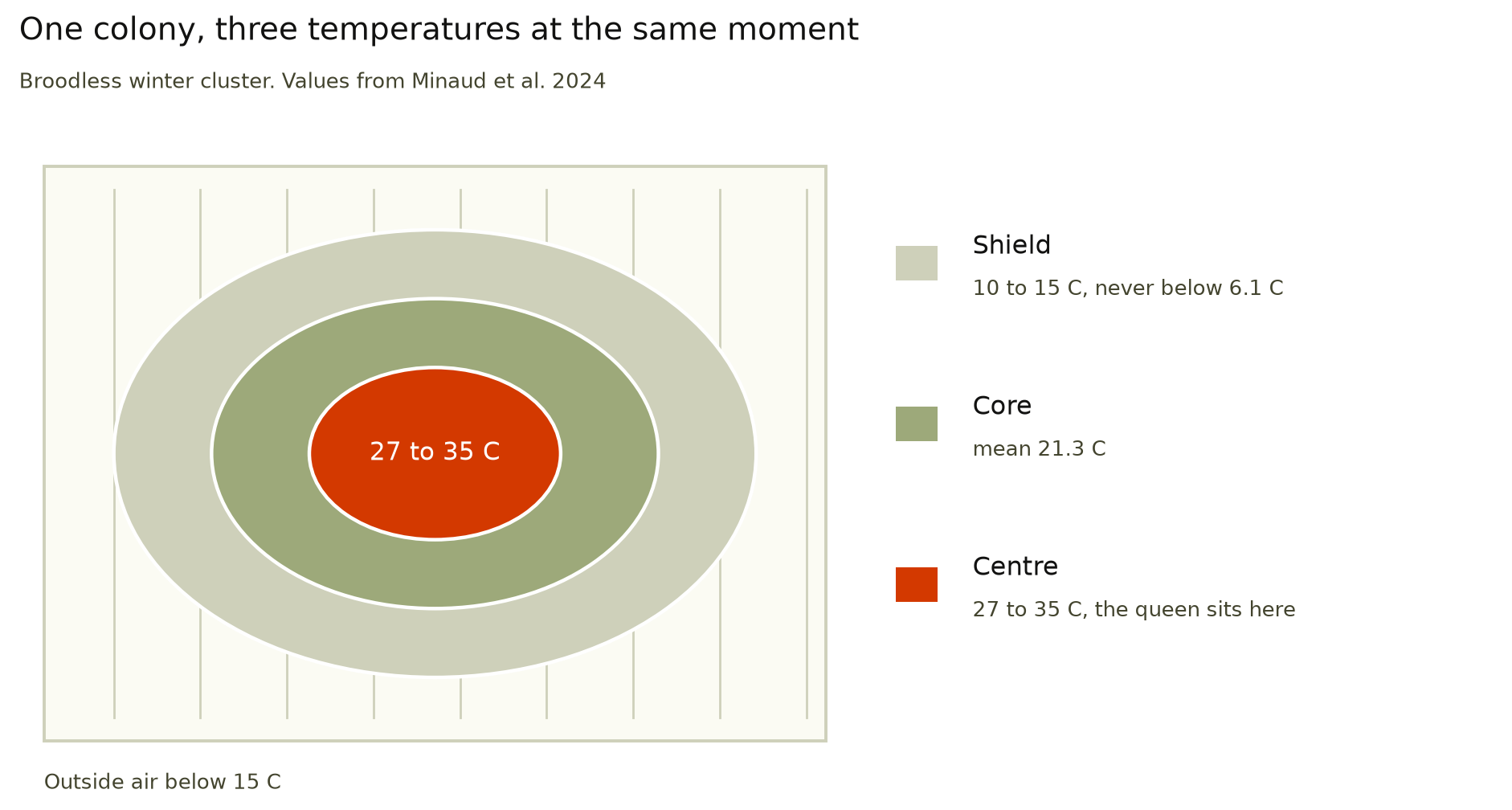
The cluster forms when outside air drops below about 15 °C. Its mantle of tightly packed bees sits at 10 to 15 °C and never falls below 6.1 °C, its core averages 21.3 °C across a range of 18 to 29 °C, and the centre where the queen sits is held at 27 to 35 °C (Minaud et al., 2024a). Those figures describe one colony on one night. A probe touching the mantle and a probe in the centre are both measuring the colony correctly, and they will disagree by twenty degrees.
The cluster is not a fixed object either. It contracts in cold weather, relaxes when conditions allow air through, and at an outside temperature below 5 °C stops contracting further and produces additional heat instead (Minaud et al., 2024a). The distance between any fixed sensor and the nearest bee is therefore a variable that changes with the weather, several times a week.
Then the cluster moves. Through the winter it shifts, expands and changes shape to keep access to the honey reserves it has not yet eaten (Minaud et al., 2024a), which is why a colony can starve a few centimetres from full combs when a long cold spell prevents it from travelling. To a fixed sensor, that movement looks identical to a colony cooling towards death.
The way out is statistical rather than absolute. Thermal amplitude across the nest separates surviving from dying colonies, the stability of the maximum temperature indicates whether brood is present, and the spread of temperatures across sensors estimates how much brood there is (Minaud et al., 2024b). Those are properties of a distribution, not of a reading.
From temperature to data fusion
A downward shift with rising daily variability can precede brood disease. It can equally mean a failing or absent queen, a shrinking brood area, a cold snap, or a cluster that has simply moved away from the probe. An upward shift can mean brood rearing, a swarm, a heatwave, transport, or a badly ventilated box. The thermal responses are similar and the causes are not.
Two further effects tighten the margin. Hive temperature and CO₂ concentration both show circadian rhythms that persist without external cues (Meikle & Weiss, 2025), so a daily pattern has a baseline that is not driven by colony health at all. And honey bee thermal receptors resolve changes as small as 0.2 °C, a figure taken as the design target for hive sensor platforms (Gupta et al., 2026).
Temperature tells you that the colony’s thermal state has changed, and roughly when. A chemically independent channel is what can tell you why. Volatile organic compounds are the obvious candidate, because brood diseases change the smell of a nest before they change its appearance, and headspace volatiles from a colony can be used to identify the agent non-invasively (Asiri et al., 2025). We have written more about how colonies defend themselves against disease in The self-protecting hive.
This is the design principle behind the Apisense platform. Continuous in-hive measurement of temperature alongside gases and volatile compounds, made possible by the Apisense VitalSensor, gives two complementary views of the same colony that fail in different ways, and a chemical channel does not care where the cluster has drifted to. Bee Health Intelligence, in practice, means fusing those channels rather than adding sensors and hoping. The temperature findings summarised here were presented at the annual meeting of the German-speaking bee research association in Braunschweig in March 2026 (Bryś et al., 2026). The presentation prompted a lively discussion with researchers and beekeepers, and it led to new contacts and collaborations that now inform how we design and interpret our field measurements.
References
- Alqarni, A. S., Ali, H., Iqbal, J., Owayss, A. A., & Smith, B. H. (2019). Expression of heat shock proteins in adult honey bee (Apis mellifera L.) workers under hot-arid subtropical ecosystems. Saudi Journal of Biological Sciences, 26(7), 1372 to 1376. https://pmc.ncbi.nlm.nih.gov/articles/PMC6864156
- Asiri, A., Perkins, S. E., & Müller, C. T. (2025). The smell of infection, disease surveillance in insects using volatile organic compounds. Agricultural and Forest Entomology, 27(1), 81 to 89. https://doi.org/10.1111/afe.12651
- Besson, O., et al. (2021). Bee Cluster 3D, a system to monitor the temperature in a hive over time. arXiv:2101.03125. https://arxiv.org/abs/2101.03125
- Bryś, M. S., Kądziołka, B., Stasiowska, D., Wierzbiński, M., Cibor, S. (2026) From temperature to data fusion, effective monitoring of honeybee colony health. Presented at the meeting of the German speaking bee research association, Braunschweig, March 2026.
- Bujok, B., Kleinhenz, M., Fuchs, S., & Tautz, J. (2002). Hot spots in the bee hive. Naturwissenschaften, 89, 299 to 301. https://doi.org/10.1007/s00114-002-0338-7
- Ferrari, S., Silva, M., Guarino, M., & Berckmans, D. (2008). Monitoring of swarming sounds in bee hives for early detection of the swarming period. Computers and Electronics in Agriculture, 64(1), 72 to 77. https://doi.org/10.1016/j.compag.2008.05.010
- Flores, J. M., Ruiz, J. A., Ruz, J. M., Puerta, F., Bustos, M., Padilla, F., & Campano, F. (1996). Effect of temperature and humidity of sealed brood on chalkbrood development under controlled conditions. Apidologie, 27, 185 to 192. https://www.apidologie.org/articles/apido/abs/1996/04/Apidologie_0044-8435_1996_27_4_ART0001/
- Groh, C., Tautz, J., & Rössler, W. (2004). Synaptic organization in the adult honey bee brain is influenced by brood temperature control during pupal development. PNAS, 101(12), 4268 to 4273. https://doi.org/10.1073/pnas.0400773101
- Gupta, S. D., Erickson, J., Rinehart, J., Braaten, B. D., & Eshkabilov, S. (2026). A wireless sensor platform for beehive monitoring. Sensors, 26(6), 1846. https://doi.org/10.3390/s26061846
- Heinrich, B. (1979). Thermoregulation of African and European honeybees during foraging, attack, and hive exits and returns. Journal of Experimental Biology, 80(1), 217 to 229.
- Hölldobler, B., & Wilson, E. O. (2009). The Superorganism, the Beauty, Elegance, and Strangeness of Insect Societies. W. W. Norton & Company, New York.
- Jones, J. C., Myerscough, M. R., Graham, S., & Oldroyd, B. P. (2004). Honey bee nest thermoregulation, diversity promotes stability. Science, 305(5682), 402 to 404. https://doi.org/10.1126/science.1096340
- Jones, J. C., Helliwell, P., Beekman, M., Maleszka, R., & Oldroyd, B. P. (2005). The effects of rearing temperature on developmental stability and learning and memory in the honey bee, Apis mellifera. Journal of Comparative Physiology A, 191, 1121 to 1129. https://doi.org/10.1007/s00359-005-0035-z
- Kleinhenz, M., Bujok, B., Fuchs, S., & Tautz, J. (2003). Hot bees in empty broodnest cells, heating from within. Journal of Experimental Biology, 206(23), 4217 to 4231. https://doi.org/10.1242/jeb.00680
- Meikle, W. G., & Holst, N. (2015). Application of continuous monitoring of honeybee colonies. Apidologie, 46(1), 10 to 22. https://doi.org/10.1007/s13592-014-0298-x
- Meikle, W. G., Weiss, M., Maes, P. W., et al. (2017). Internal hive temperature as a means of monitoring honey bee colony health in a migratory beekeeping operation before and during winter. Apidologie. https://doi.org/10.1007/s13592-017-0512-8
- Meikle, W. G., & Weiss, M. (2025). Temperature and CO2 concentration in honey bee hives exhibit circadian rhythms. Scientific Reports, 15. https://doi.org/10.1038/s41598-025-03614-3
- Minaud, É., Rebaudo, F., Davidson, P., Hatjina, F., Hotho, A., Mainardi, G., Steffan-Dewenter, I., Vardakas, P., Verrier, P., & Requier, F. (2024a). How stressors disrupt honey bee biological traits and overwintering mechanisms. Heliyon, 10(14), e34390. https://doi.org/10.1016/j.heliyon.2024.e34390
- Minaud, É., Rebaudo, F., Mainardi, G., Vardakas, P., Hatjina, F., Steffan-Dewenter, I., & Requier, F. (2024b). Temperature in overwintering honey bee colonies reveals brood status and predicts colony mortality. Ecological Indicators, 112961. https://doi.org/10.1016/j.ecolind.2024.112961
- Mráz, P., Hýbl, M., Kopecký, M., Bohatá, A., Konopická, J., Hoštičková, I., Konvalina, P., Šipoš, J., Rost, M., & Čurn, V. (2021). The effect of artificial media and temperature on the growth and development of the honey bee brood pathogen Ascosphaera apis. Biology, 10(5), 431. https://doi.org/10.3390/biology10050431
- Nürnberger, F., Härtel, S., & Steffan-Dewenter, I. (2018). The influence of temperature and photoperiod on the timing of brood onset in hibernating honey bee colonies. PeerJ, 6, e4801. https://doi.org/10.7717/peerj.4801
- Owens, C. D. (1971). The thermology of wintering honey bee colonies. USDA Technical Bulletin 1429. https://ageconsearch.umn.edu/record/171857
- Seeley, T. D. (1989). The honey bee colony as a superorganism. American Scientist, 77(6), 546 to 553. https://www.semanticscholar.org/paper/c718628d4e61fe781ac0ddf5e5ae26d8245f1495
- Stabentheiner, A., Pressl, H., Papst, T., Hrassnigg, N., & Crailsheim, K. (2003). Endothermic heat production in honeybee winter clusters. Journal of Experimental Biology, 206(2), 353 to 358. https://journals.biologists.com/jeb/article/206/2/353/13914/
- Stabentheiner, A., Kovac, H., & Brodschneider, R. (2010). Honeybee colony thermoregulation, regulatory mechanisms and contribution of individuals in dependence on age, location and thermal stress. PLoS ONE, 5(1), e8967. https://doi.org/10.1371/journal.pone.0008967
- Stabentheiner, A., Kovac, H., Mandl, M., & Käfer, H. (2021). Coping with the cold and fighting the heat, thermal homeostasis of a superorganism, the honeybee colony. Journal of Comparative Physiology A, 207(3), 337 to 351. https://doi.org/10.1007/s00359-021-01464-8
- Stalidzans, E., & Berzonis, A. (2013). Temperature changes above the upper hive body reveal the annual development periods of honey bee colonies. Computers and Electronics in Agriculture, 90, 1 to 6. https://doi.org/10.1016/j.compag.2012.10.003
- Tautz, J., Maier, S., Groh, C., Rössler, W., & Brockmann, A. (2003). Behavioral performance in adult honey bees is influenced by the temperature experienced during their pupal development. PNAS, 100(12), 7343 to 7347. https://doi.org/10.1073/pnas.1232346100
- von Knoblauch, T., Jensen, A. B., Mülling, C. K. W., Aupperle-Lellbach, H., & Genersch, E. (2024). Chalkbrood disease caused by Ascosphaera apis in honey bees, morphological and histological changes in infected larvae. Veterinary Sciences, 11, 415. https://doi.org/10.3390/vetsci11090415
- Zacepins, A., Kviesis, A., Stalidzans, E., Liepniece, M., & Meitalovs, J. (2016). Remote detection of the swarming of honey bee colonies by single point temperature monitoring. Biosystems Engineering, 148, 76 to 80. https://doi.org/10.1016/j.biosystemseng.2016.05.012
- Zhu, X., Wen, X., Zhou, S., Xu, X., Zhou, L., & Zhou, B. (2019). The temperature increase at one position in the colony can predict honey bee swarming (Apis cerana). Journal of Apicultural Research, 58(4). https://doi.org/10.1080/00218839.2019.1632149